
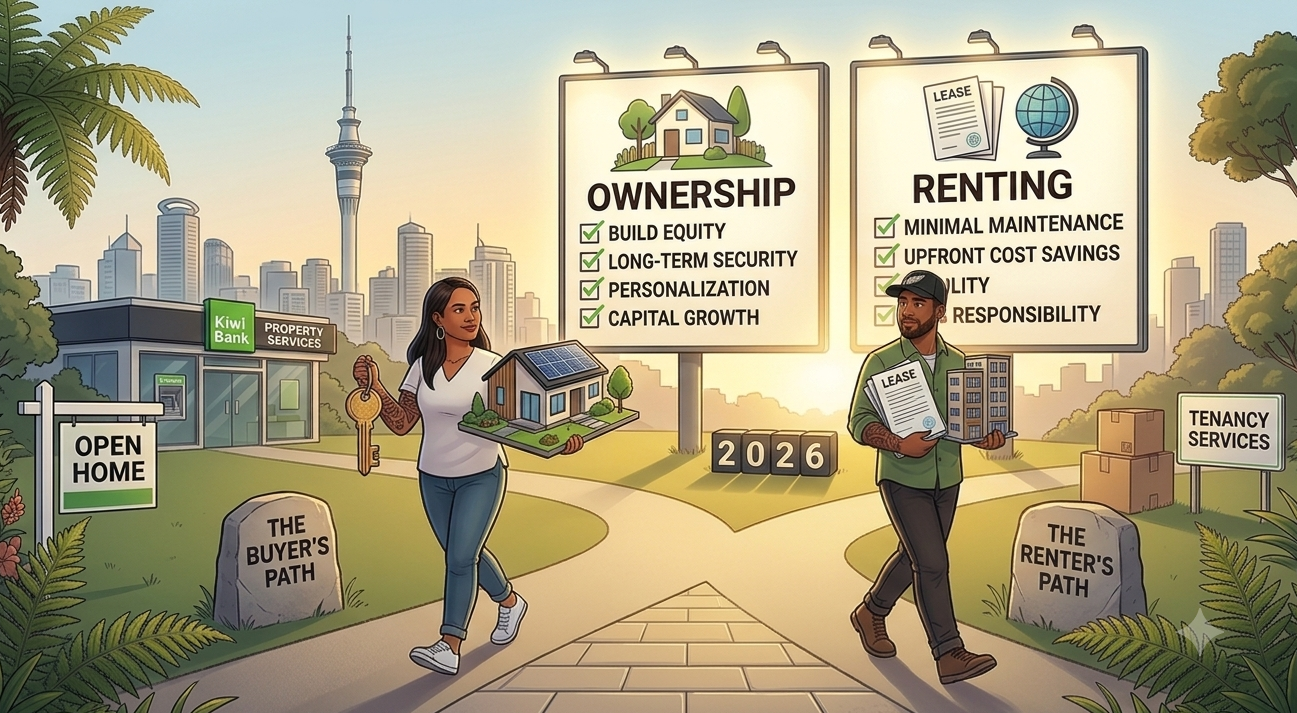
You’re not automatically throwing money away by renting, but buying a house is mathematically likely to leave you wealthier over a 20-year timeline, provided you can comfortably manage the massive upfront costs and strict new borrowing rules.
With New Zealand house prices sitting incredibly high compared to our local incomes, and 2026 mortgage rates floating around the 5% mark, every Kiwi eventually faces the exact same dilemma: do you buy a house and lock yourself into a 30-year mortgage, or do you keep flatting and invest the difference?
For generations, the standard New Zealand advice from parents and grandparents has been that “renting is dead money.” The Kiwi dream was built on getting a quarter-acre section, paying it off, and retiring mortgage-free. But the financial landscape in 2026 is vastly different from when your parents bought their first home. With the Reserve Bank of New Zealand (RBNZ) enforcing strict Debt-to-Income (DTI) ratios, skyrocketing insurance premiums, and the rising cost of living across Auckland, Wellington, and the regions, the buy vs rent debate is more complex—and more relevant—than ever before.
In this guide, we are going to run a genuine, numbers-based comparison to help you figure out what makes the most sense for your wallet.
The True Cost of Buying: Beyond the Mortgage Payment
It is dangerously easy to jump onto a banking website, look at a 1-year fixed mortgage rate of around 4.89%, and think to yourself, “I can afford that weekly repayment!” But buying a home in NZ involves a mountain of hidden, ongoing costs that renters simply never have to worry about.
If you want to compare buying to renting, you need to factor in the “unrecoverable costs” of homeownership. These are expenses that don’t build your equity; they just disappear from your bank account:
- Mortgage Interest: When you first take out a mortgage, the vast majority of your weekly repayment goes straight to the bank as profit. If you borrow $560,000 at a 5.5% interest rate, you are paying tens of thousands of dollars a year purely in interest. It takes years before a meaningful chunk of your repayment actually goes toward paying down the principal loan.
- Council Rates: Whether you’re in the heart of Auckland City or out in regional Waikato, local council rates are climbing rapidly to cover infrastructure deficits. You need to budget anywhere from $3,000 to $4,500 a year, and you can expect that number to increase annually.
- House and Contents Insurance: Thanks to recent severe weather events across the country, insurance premiums have surged. Lenders require you to have comprehensive insurance before they hand over the mortgage money. Depending on where you live, this can easily add another $2,000 to $3,500 to your annual budget.
- The 1-2% Maintenance Rule: Houses decay. The general rule of thumb is to budget 1% to 2% of your property’s value every single year for maintenance. For a $700,000 home, that is $7,000 to $14,000 annually. You might not spend it all in one year, but eventually, the hot water cylinder will blow, the spouting will need replacing, or the house will need repainting.
Want to see exactly how much interest you’ll pay? Run your numbers through our Weekly Mortgage Repayment Calculator.
The True Cost of Renting: Freedom, but with Financial Catch-Ups
On the flip side, renting is absolutely not a free ride. While renting gives you maximum flexibility to chase job opportunities or move closer to the beach, it comes with its own set of brutal financial realities in 2026.
- Rent Inflation: Rent almost never goes down. As a tenant, your housing costs are entirely exposed to market forces. If average rents rise by 3% to 4% a year, a $650 per week rental will cost you over $870 a week in a decade’s time.
- No Capital Gain: New Zealand does not have a comprehensive capital gains tax on the family home. When you own property, any increase in its value is effectively tax-free wealth (provided you don’t fall foul of the bright-line test, which doesn’t apply to your main home anyway). As a renter, you completely miss out on this leveraged, tax-free growth.
- The “Discipline” Factor: The only way renting beats buying financially is if you are highly disciplined. To come out ahead, you must take the money you saved on a deposit, plus the money you save every week by not paying rates, insurance, and home maintenance, and aggressively invest it into assets like index funds or term deposits. If you just spend that extra money on a new ute or weekends away, renting will always leave you poorer.
Worked Example: $700,000 Property Over 20 Years — Buy vs Invest-the-Deposit
Let’s run the real numbers to see exactly what happens over a 20-year timeframe. We’ll look at a $700,000 property—perhaps a modern townhouse in Christchurch or a starter home in the regions.
The Buyer: They have a $140,000 deposit (a 20% chunk to keep the bank happy and avoid low-equity premiums). They borrow the remaining $560,000 on a 30-year term at an average long-term interest rate of 5.5%. They also pay rates, insurance, and maintenance, bringing their total weekly housing cost to around $935.
The Renter (The Investor): They decide not to buy. Instead, they take that exact same $140,000 deposit and invest it in a diversified index fund that returns a realistic 6% per year after taxes and fees. They rent a similar house for $650 a week. Because renting is currently cheaper than the buyer’s $935 total weekly cost, the renter diligently invests the $285 difference into their fund every single week.
Assumption: Property values grow at an average of 4% per year, and rent increases by 3% per year (which gradually shrinks the renter’s weekly investment capability).
The 20-Year Net Worth Comparison Table
| Timeframe | The Buyer’s Net Worth (Home Value minus Mortgage) | The Renter’s Net Worth (Total Investment Portfolio) | Who is winning? |
| Year 5 | $337,000 | $270,000 | Buyer (Capital gains boost early equity) |
| Year 10 | $583,000 | $445,000 | Buyer (Mortgage principal is rapidly shrinking) |
| Year 20 | $1,250,000 | $994,000 | Buyer (Leverage and tax-free growth pull away) |
As the table shows, the buyer ends up significantly wealthier after two decades. Why? Because of leverage. The buyer is earning a 4% capital gain on the entire $700,000 asset, even though they only put in $140,000 of their own money. The renter is only earning returns on their cash balance.
However, nearly having a million dollars in liquid shares as a renter is nothing to sneeze at! Renting only works if you actually invest the difference.
When Buying Beats Renting
Even with the high costs, buying is generally the superior financial choice if you meet the following criteria:
- You have a long time horizon: If you plan to live in the same house (or at least keep it) for 10 years or more, the upfront costs of buying (lawyers, valuation fees, building reports) are easily absorbed by long-term capital growth.
- You want forced savings: Let’s be honest, most of us aren’t perfectly disciplined investors. A mortgage forces you to build wealth every time you make a repayment.
- You value stability: When you own the home, you don’t have to worry about a landlord deciding to sell the property or moving their extended family in, triggering a 90-day notice to vacate.
When Renting Beats Buying
Renting can absolutely be the smarter financial move in specific scenarios:
- You have a short time horizon: If you plan to move overseas, change cities, or upgrade in less than 5 years, buying is highly risky. A flat or falling market could leave you with negative equity, and the transaction costs of selling will wipe out any small gains.
- The property market is heavily overvalued: In extremely high-cost areas, the rent you pay is sometimes significantly lower than the interest portion of a mortgage. If house prices stagnate while interest rates stay high, renters come out ahead.
- You want pure flexibility: If your career requires you to be agile, being tied down by a 30-year mortgage and a physical asset is a massive burden.
How the 2026 RBNZ DTI Ratio Affects Your Decision
You might read all of this and think, “Great, I’m ready to buy!” Unfortunately, the decision might not be entirely up to you. In 2024, the Reserve Bank introduced Debt-to-Income (DTI) restrictions, and by 2026, these rules are a hard reality for anyone trying to get a mortgage.
The DTI rules strictly limit how much you can borrow based on your gross (pre-tax) income:
- Owner-Occupiers: You generally cannot borrow more than 6 times your total household income.
- Investors: You generally cannot borrow more than 7 times your total household income.
What does this mean in real NZ dollars?
If you and your partner have a combined gross household income of $130,000 a year, your absolute maximum total debt limit is $780,000 (6 x $130,000).
But wait—it gets tighter. “Total debt” means all your debt. If you have a $20,000 student loan, a $15,000 car loan on Hire Purchase, and a credit card with a $5,000 limit (even if the balance is zero, banks count the limit), that is $40,000 of existing debt. You must subtract that from your limit. Your actual maximum mortgage borrowing capacity drops to $740,000.
Because of these DTI limits, many Kiwis with great credit scores and solid deposits are forced to continue renting simply because their incomes aren’t high enough to service the debt required to buy at current market prices. If you find yourself in this boat, the best thing you can do is optimise your renting strategy by aggressively contributing to your KiwiSaver and index funds.
Emotional vs Financial Factors: The Right Answer Differs
We’ve talked a lot about numbers, but deciding where you live is inherently emotional. The “right” answer differs for every single person.
Financially, having a huge chunk of your net worth tied up in a single, illiquid asset (a house) in one specific suburb of New Zealand is actually quite risky compared to holding a globally diversified stock portfolio. But emotionally? You can’t live inside an index fund.
Homeownership allows you to paint the walls whatever colour you want, hang pictures without using command strips, and adopt that dog you’ve always wanted without begging a property manager for permission. Conversely, renting means when the roof starts leaking at 2 AM on a Sunday, you just pick up the phone and call the landlord—it’s their financial headache to solve, not yours.
Frequently Asked Questions
Is it ever too late to buy a house in NZ?
No, but your strategy must change as you get older. If you buy your first home at 45, a standard 30-year mortgage will take you well past the retirement age of 65. Banks will scrutinize your exit strategy (how you plan to pay the mortgage when you stop working). You may need to aim for a smaller, cheaper property to ensure it is paid off before you retire, or aggressively overpay your mortgage while you are still working.
What deposit do I really need in 2026?
Ideally, you want a 20% deposit to avoid low-equity interest rate margins and expensive lender’s mortgage insurance. However, banks are allowed a small “speed limit” to lend to people with less than 20%. If you qualify for a Kāinga Ora First Home Loan, you can buy with just a 5% deposit, provided you meet the income caps and are buying a home to live in. Don’t forget you can withdraw almost all of your KiwiSaver to use toward your deposit.
Do I pay tax on my investment funds if I choose to rent?
Yes. If you choose to invest your deposit in shares or managed funds instead of property, you will pay tax on the dividends and income generated. Most KiwiSaver and New Zealand managed funds are PIE (Portfolio Investment Entity) funds. The maximum tax rate on a PIE fund is capped at 28% (your Prescribed Investor Rate), which is generally lower than the top personal income tax brackets.
Does the bright-line test matter if I’m buying a home to live in?
No. The IRD’s bright-line property rule is effectively a capital gains tax on investment properties bought and sold within a specific timeframe. However, the “main home exemption” means if you buy a house, live in it as your primary residence, and later sell it, you do not pay any tax on the profit. This tax advantage is one of the biggest financial benefits of homeownership in Aotearoa.
Conclusion: Making the Call
Ultimately, if you have the deposit, your income fits within the RBNZ’s DTI limits, and you plan to stay put for at least a decade, buying a house in New Zealand is still the most reliable path to long-term wealth. The leverage you get from a mortgage, combined with tax-free capital gains on your primary residence, is incredibly hard to beat.
But if you are priced out for now, or you just prefer the freedom of flatting, don’t panic. Renting is not a financial death sentence—as long as you treat your savings like a non-negotiable expense and invest the difference wisely.
Ready to figure out exactly where you stand?
Check out our tools below to run your own numbers:
👉 Home Affordability Calculator + Weekly Mortgage Repayment Calculator
Disclaimer: This is general information, not personalized financial advice. This article provides general information and educational content only. We are not registered financial advisers. Always speak to a licensed financial advice provider before making major changes to your KiwiSaver fund, investment portfolio, or mortgage strategy.
Date: 10/06/2026
Author: Luca Tariciotti