🔍

    Category: Savings & Investments

    • Foreign Investment Fund (FIF) Tax NZ: The New $100,000 Threshold Explained

      Foreign Investment Fund (FIF) Tax NZ: The New $100,000 Threshold Explained

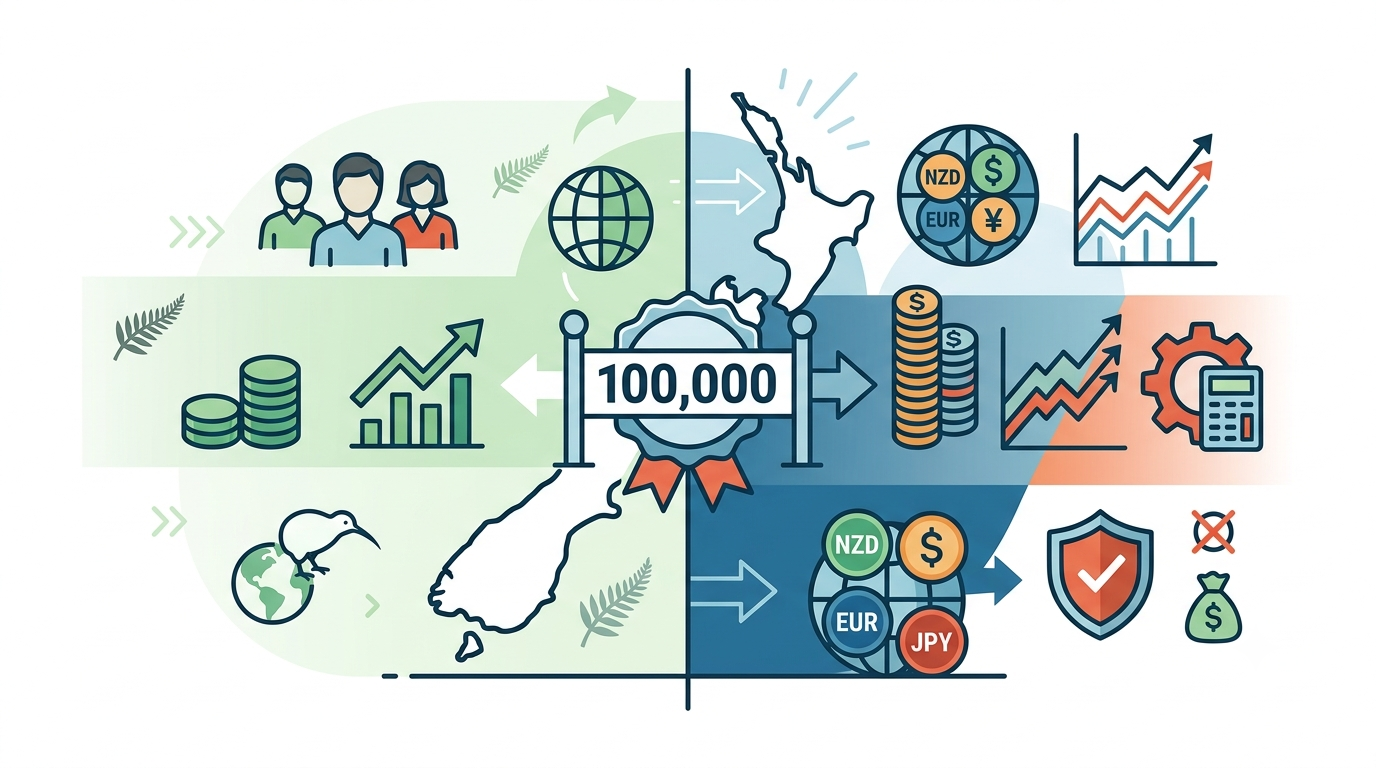
      Budget 2026 has proposed doubling the Foreign Investment Fund (FIF) tax threshold from $50,000 to $100,000, meaning everyday Kiwi investors will soon be able to hold twice as many direct overseas shares before facing complex Inland Revenue (IRD) tax calculations.

      What is the FIF Regime and Why Does NZ Tax Unrealised Gains?

      If you have been investing through platforms like Sharesies, Hatch, or Kernel, you have probably heard whispers of the dreaded “FIF tax.” Let’s clear the air: FIF stands for Foreign Investment Fund. It is the IRD’s way of taxing Kiwis who own shares in overseas companies or funds.

      New Zealand does not have a comprehensive capital gains tax, but we do tax income. Historically, the IRD noticed a problem: Kiwis were buying growth stocks in the US (like tech companies that reinvest all their profits and pay zero dividends) to avoid paying any tax. Meanwhile, a Kiwi investing in a local New Zealand business paying a 5% dividend was being taxed on that income every year.

      To level the playing field and stop tax revenue from leaking overseas, the government created the FIF rules. Under these rules, if you hold a significant amount of foreign shares, the IRD assumes you are making a return on them—and taxes you on that “deemed” return, regardless of whether you sold the shares or actually received a cash dividend.

      The New $100,000 Threshold: What Changes on 1 April 2026?

      For the last two decades, the FIF rules only kicked in if your overseas investments cost you more than $50,000. This “de minimis threshold” was designed to protect small-time retail investors from accounting nightmares. However, the $50,000 limit was set back in the year 2000 and has never been adjusted for inflation.

      Budget 2026 delivered long-overdue news: a proposal to double this threshold to $100,000.

      • Effective Date: The change is scheduled to take effect from 1 April 2026 (the start of the 2026/2027 tax year).
      • Legislative Warning: It is incredibly important to note that this is a Budget proposal and remains subject to the final legislation passing through Parliament.
      • What it means for you: If your foreign investments remain under this new $100,000 limit, you can ignore the complex FIF rules entirely. You simply declare and pay tax on the actual dividends you receive, exactly as you would with money sitting in a local savings account.

      Cost Basis vs Market Value: The Golden Rule of FIF

      This is where 90% of Kiwi investors get confused. The $100,000 threshold is based entirely on your cost basis, not the current market value of your portfolio.

      Cost basis simply means the actual New Zealand Dollars (NZD) you spent to buy the shares, including the brokerage fees at the time of purchase. The IRD does not care if your tech stocks went to the moon or crashed to zero; they only care about how much money you put in.

      Example 1: The Buy-and-Hold Winner

      Sarah bought $80,000 NZD worth of Vanguard S&P 500 ETFs three years ago. Today, thanks to a massive bull market, her portfolio is worth $130,000.

      Is she caught by FIF? No. Her cost basis is still $80,000. Even though her portfolio value is way over $100,000, she sits safely below the proposed threshold.

      Example 2: The Dividend Reinvestment Trap

      Mark buys $95,000 NZD worth of US shares. He leaves the “auto-reinvest dividends” feature turned on inside his Hatch account. Over the next year, his shares pay out $6,000 in dividends, which are automatically used to buy more shares.

      Is he caught by FIF? Yes. Reinvesting dividends counts as a new purchase. Mark’s cost basis just climbed from $95,000 to $101,000. He has now breached the threshold without ever transferring another dollar from his NZ bank account.

      How Couples Can Effectively Double Their Exemption

      The FIF threshold is a per-person allowance. It is not assessed per household.

      If you and your partner are investing for your future, you can effectively shelter $200,000 of overseas investments from the FIF rules by keeping your finances separated.

      • Partner A can hold up to $100,000 (cost basis) in their own name.
      • Partner B can hold up to $100,000 (cost basis) in their own name.

      If you invest through a joint account, the threshold is typically split, but keeping accounts in individual names makes the accounting much cleaner and ensures neither person accidentally tips the other over the limit. Furthermore, if you are setting up accounts for your children, each child is treated as an individual taxpayer with their own $100,000 threshold.

      Which Platforms and Funds Are Actually Affected?

      Thanks to the rise of easy-to-use digital platforms, Kiwis are sending more money overseas than ever before. But not all investment vehicles trigger the FIF rules.

      New Zealand-domiciled PIE (Portfolio Investment Entity) funds are handled differently. If you buy a global share fund that is structured as a local PIE, the fund manager handles the FIF tax internally. Even better, PIE funds cap your tax rate at 28% (the maximum Prescribed Investor Rate, or PIR), which is a massive benefit if your personal income pushes you into the 30%, 33%, or 39% income tax brackets. PIE funds do not count toward your personal $100,000 FIF threshold.

      Here is a quick reference guide to see what counts toward your limit:

      Platform / Investment TypeCounts Towards Your $100k FIF Threshold?
      Sharesies (Direct US/UK Shares)Yes
      Hatch (Direct US Shares and ETFs)Yes
      Kernel (Direct US Shares)Yes
      Kernel (NZ-Domiciled PIE Funds)No
      Smartshares / Simplicity (PIE Funds)No
      Direct ASX Shares (e.g., Woolworths, BHP)Generally No
      ASX-Listed ETFs (e.g., Vanguard Global ETFs)Yes

      The Australian Exemption Most Kiwis Don’t Know About

      You might have noticed “Direct ASX Shares” listed as exempt in the table above.

      Under IRD rules, shares in most Australian resident companies listed on the Australian Securities Exchange (ASX) are entirely exempt from FIF. The IRD treats these similarly to New Zealand shares. If you buy $150,000 worth of shares in the Commonwealth Bank of Australia or BHP, you don’t need to worry about FIF.

      The Catch: This exemption applies to individual Australian companies. It does not apply to Australian-listed ETFs (Exchange Traded Funds) that invest globally. If you buy an ASX-listed Vanguard global ETF, that absolutely counts toward your $100,000 FIF threshold.

      What Happens if You Cross the Threshold Mid-Year?

      The FIF test is a strict daily measurement.

      If your cost basis breaches $100,000 for even a single day during the New Zealand financial year (which runs from 1 April to 31 March), your entire overseas portfolio becomes subject to the FIF rules for that entire year.

      You cannot simply sell down your shares on March 25th to sneak back under the limit before the tax year ends. Furthermore, the tax applies to every dollar in your portfolio, not just the excess. If your cost basis hits $101,000, you are taxed on the full $101,000—not just the $1,000 that tipped you over the edge.

      If you are hovering near the threshold, you need to turn off automatic dividend reinvestments, closely monitor your foreign currency purchases, and maintain impeccable records of your NZD purchase costs.

      FDR vs CV: How is FIF Tax Actually Calculated?

      If you do cross the threshold, the IRD requires you to calculate your tax using one of two methods. You are allowed to calculate both and choose the one that gives you the lower tax bill, but you must apply the same method to your entire overseas portfolio for that year.

      1. Fair Dividend Rate (FDR) Method

      The FDR method is the most common. The IRD simply assumes your portfolio grew by 5% over the year, based on its opening value on 1 April.

      • The Math: If your portfolio’s market value on 1 April is $120,000, your deemed income is $6,000 (5% of $120,000).
      • The Tax: You then add that $6,000 to your regular income and pay your marginal tax rate on it. If you earn $80,000 from your day job (putting you in the 33% tax bracket), your FIF tax bill will be $1,980.
      • When to use it: FDR is fantastic in a booming bull market. If your portfolio actually grew by 20%, you are only paying tax as if it grew by 5%.

      2. Comparative Value (CV) Method

      The CV method calculates the actual return of your portfolio (capital growth plus any dividends).

      • The Math: (Closing Value + Sales + Dividends) – (Opening Value + Purchases).
      • When to use it: The CV method is your safety net. If the global stock market crashes and your portfolio loses money, your CV return is zero or negative. Because you can choose the lower of the two methods, you would select CV during a market downturn and effectively pay zero FIF tax for that year (though you cannot claim the loss against your day job income).

      Frequently Asked Questions

      Does KiwiSaver count towards my FIF threshold?

      No. Your KiwiSaver is structured as a PIE (Portfolio Investment Entity). Any foreign investments held within your KiwiSaver are managed by your provider, taxed at your Prescribed Investor Rate (up to a maximum of 28%), and do not count toward your personal $100,000 FIF threshold.

      What about my partner’s portfolio?

      The FIF threshold applies per individual taxpayer. Your partner’s investments do not count toward your threshold, provided the investment accounts are in their sole name. If you have joint accounts, the cost base is generally split 50/50.

      Is the $100,000 threshold definitely law yet?

      As of July 2026, the doubling of the threshold from $50,000 to $100,000 was proposed in Budget 2026 and remains subject to legislation passing. It is scheduled to apply retroactively from 1 April 2026, but investors should monitor IRD announcements before relying on it completely.

      What happens if my shares crash in value while under the threshold?

      If your cost basis (what you originally paid) is $90,000, but a market crash drops the value of your portfolio to $60,000, you are still under the threshold. You only pay tax on the actual dividends you receive.

      Can I deduct brokerage fees from my cost basis?

      No, brokerage fees actually increase your cost basis. If you buy $1,000 worth of shares and pay a $5 brokerage fee, the cost basis added toward your threshold is $1,005.

      Conclusion & Next Steps

      The proposed jump to a $100,000 FIF threshold is a massive win for everyday Kiwi investors. It allows for much broader diversification into the US and UK markets without the headache of hiring an accountant just to figure out your fair dividend rate.

      However, the golden rules remain: track your NZD cost basis religiously, beware of automatic dividend reinvestments pushing you over the line, and remember that breaching the limit by a single dollar pulls your entire overseas portfolio into the FIF net.

      If you are getting close to the limit and want to see exactly how much tax you might be on the hook for under both the FDR and CV methods, take the guesswork out of the equation.

      Use our FIF Tax Calculator to see whether you’re likely to be affected and estimate your potential tax bill for the current financial year.

      Disclaimer: This is general information, not personalized financial advice. This article provides general information and educational content only. We are not registered financial advisers. Always speak to a licensed financial advice provider before making major changes to your KiwiSaver fund, investment portfolio, or mortgage strategy.
    • NZ Emergency Fund: How Much You Need and Where to Keep It

      NZ Emergency Fund: How Much You Need and Where to Keep It

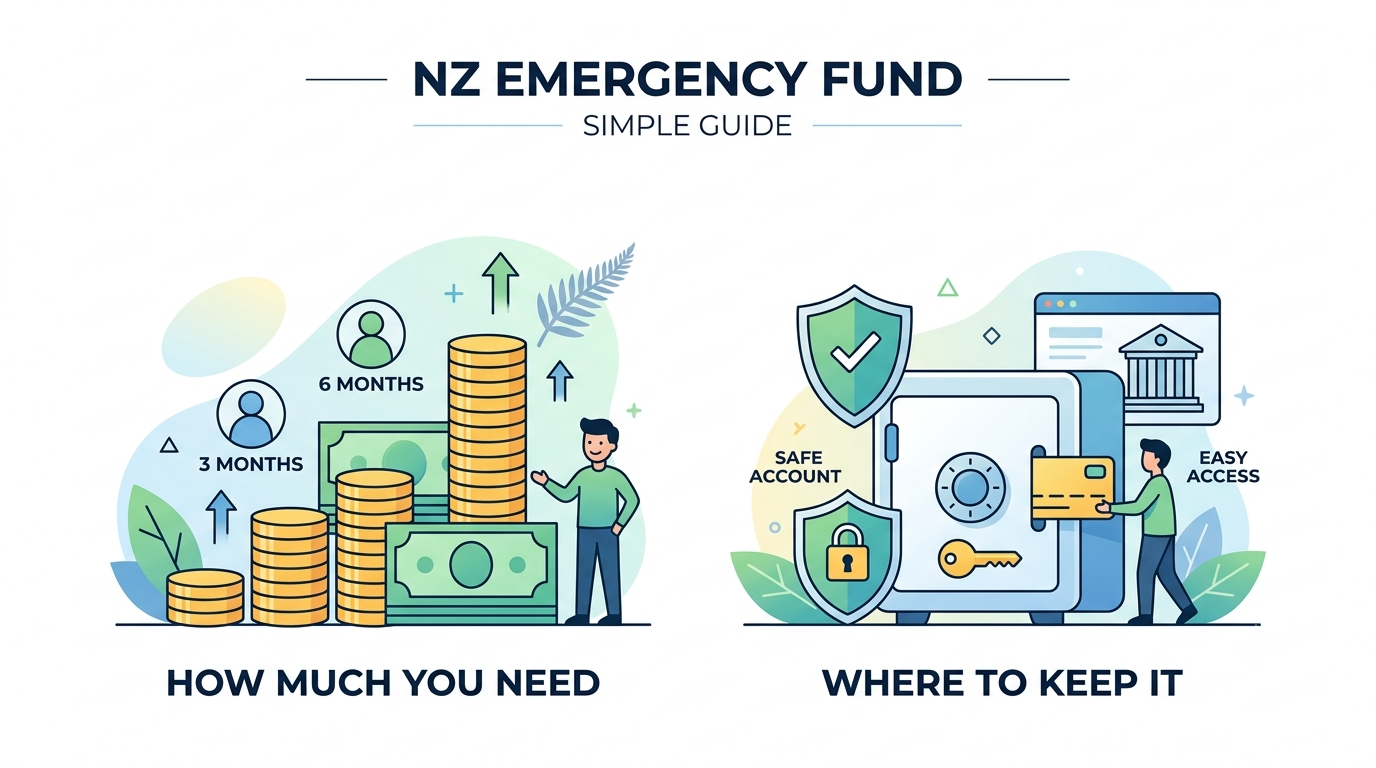
      To confidently weather unexpected financial storms in New Zealand, your emergency fund should cover from three to six months of your essential living expenses. With the rising cost of living across Aotearoa, having this cash buffer means a sudden car repair or medical event won’t force you into high-interest credit card debt or a Hire Purchase trap.

      Financial advisers universally recommend having cash set aside for a rainy day, yet a surprising number of Kiwis don’t have an emergency fund—or simply don’t know how much is “enough.” If your savings are sitting in a standard, zero-interest transaction account, inflation is slowly eating your money. But if you lock it all away in long-term investments, you can’t access it when life throws a curveball.

      This guide breaks down exactly how much you need for an emergency fund, where you should keep it to beat the IRD tax brackets, and how to build it up fast without sacrificing your KiwiSaver goals.

      What is an Emergency Fund and Why Do You Need One?

      An emergency fund is a dedicated stash of money meant only for unexpected, urgent, and necessary expenses. Think of it as your personal financial shock absorber.

      If your car fails its Warrant of Fitness (WOF) and needs $1,200 of work on new tyres and brake pads, your emergency fund pays for it. If your employer undergoes restructuring and you are made redundant, your emergency fund covers your rent, power, and supermarket groceries while you hunt for a new job. If your dog swallows something they shouldn’t and needs an emergency trip to the after-hours vet, your cash buffer handles the bill.

      Without this safety net, Kiwis are often forced to rely on high-interest options like credit cards, Afterpay, Hire Purchase agreements, or personal loans. When you are already in a stressful situation, adding a debt with an interest rate of over 20% only makes it harder to get back on your feet. Building an emergency fund breaks the cycle of debt by turning a crisis into a mere inconvenience.

      The 3–6 Month Rule: How to Calculate Your Personal Target

      When figuring out how big your emergency fund should be in NZ, the golden rule is three to six months of essential living expenses.

      Notice the crucial word: essential. This target does not mean replacing your full salary. It means covering your absolute baseline survival costs if your income dropped to zero tomorrow.

      To calculate your target, you need to strip out your “wants” like dining out at restaurants, your weekend coffees, multiple streaming subscriptions, and holidays. Focus only on the non-negotiables required to keep a roof over your head and food on the table.

      Monthly Essential Expenses Example (NZD)

      Here is what a baseline “survival budget” might look like for a modest Kiwi household:

      Expense CategoryMonthly CostWhat it Covers
      Housing$2,200Rent for a flat, or minimum Mortgage payments + Council Rates
      Utilities$300Power, broadband, water, and mobile phone plans
      Food$700Supermarket groceries (basics and home-cooked meals only)
      Transport$250Petrol, Snapper/AT Hop public transport cards, basic car running costs
      Insurances$200Car, contents, health, or life insurance minimum premiums
      Debt Minimums$250Minimum required payments on existing loans or credit cards
      Total Minimum Survival$3,900 per month

      In this hypothetical example, your baseline survival number is $3,900 a month.

      • 3-Month Emergency Fund: $11,700
      • 6-Month Emergency Fund: $23,400

      Which end of the scale should you aim for? That depends entirely on your personal risk factors and living situation in New Zealand.

      [include link here]

      NZ-Specific Factors: Renting vs Owning, Job Type, and ACC

      Your magic number isn’t just about simple multiplication; it is about evaluating your personal risk. Here is how living and working in New Zealand dictates the necessary size of your safety net.

      1. Renting vs Owning a Home

      • Renters (Aim for 3 months): Renters generally have fewer surprise costs. If the oven breaks, the heat pump dies, or the roof leaks, that is the landlord’s financial responsibility. However, you are not immune to housing emergencies. If you are asked to move out unexpectedly, you need cash on hand for moving truck fees, paying double rent during the transition, and laying down a new bond (up to four weeks’ rent) while you wait weeks for Tenancy Services to refund your old one.
      • Homeowners (Aim for 3–6 months): If you recently bought a house under the current RBNZ LVR (Loan-to-Value Ratio) restrictions, you probably drained all your savings accounts just to get the keys. Rebuilding a cash buffer is your absolute first priority. As an owner, a blown hot water cylinder, a broken sewage pipe, or an unexpected council rates hike is entirely on you. You need cash ready for sudden, expensive maintenance that insurance may not cover.

      2. Job Stability and Income Type

      • Salaried Employees (Aim for 3 to 4 months): If you work for a stable government department or a large corporate entity with strong redundancy clauses (like a 4-week payout) in your employment contract, a smaller fund might suffice.
      • Contractors, Freelancers, and Tradies (Aim for 6 months): If your income fluctuates, you run your own small business, or you work seasonal jobs, you need a much larger buffer. Contractors don’t get paid sick leave or annual holiday pay. Any time off for an injury, or any delay in a client paying an invoice, immediately impacts your personal bottom line.

      3. The ACC Illusion

      New Zealand’s Accident Compensation Corporation (ACC) is a fantastic system, but it gives many Kiwis a dangerous false sense of security. ACC covers up to 80% of your income if you are forced off work due to a physical accident.

      However, ACC pays absolutely nothing if you are unable to work due to an illness (such as a cancer diagnosis, a severe heart condition, or debilitating mental burnout). Unless you have private Income Protection Insurance (which usually comes with a 4-to-12-week stand-down period before paying out anyway), an illness means relying entirely on your limited employer sick leave. Once that runs out, you are forced onto the Work and Income Supported Living Payment, which is a massive drop from a standard salary. A robust emergency fund bridges this terrifying financial gap.

      Where to Keep Your Emergency Fund in NZ

      Your emergency fund must be liquid (easy to access within a few days) and safe (not invested in volatile shares like the S&P 500 where the value could tank exactly when you need the money).

      However, keeping it in a standard transaction account earning 0% interest means inflation is silently shrinking its purchasing power every single year. With New Zealand’s Official Cash Rate hovering around 2.50%, standard transaction accounts earn virtually zero. Here are the best places to park your emergency fund in 2026:

      Options Compared

      Account TypeAccess SpeedTypical Interest Rate (2026)*Best For
      Everyday TransactionInstant~0.05% – 0.10%Never use this for emergency savings.
      Bonus Saver AccountInstant~1.50% – 2.50%Disciplined savers who meet monthly deposit rules.
      Notice Saver Account32 to 90 days~2.70% – 3.00%The “second tier” of a large emergency fund.
      Revolving Credit MortgageInstantSaves you ~6.00%+Homeowners with strict financial discipline.

      *Rates are approximate based on 2026 bank averages and subject to change.

      High-Interest Savings vs Bonus Saver Accounts

      When shopping around major NZ banks for a place to park your cash, you will encounter two main account types:

      Bonus Saver Accounts: These accounts offer a seemingly attractive rate (often around 1.50% to 2.50% p.a.), but they come with strict hoops to jump through. Usually, you must increase your balance by a set amount (e.g., $20 or $50 a month) and make zero withdrawals. If you withdraw even $1 to pay for a minor emergency, your interest rate plummets to a base rate of around 0.05% for that entire month. These accounts are great while you are actively building the fund, but punitive when you actually need to use it.

      Notice Saver Accounts: Accounts like a 32-Day or 90-Day Notice Saver often offer the highest rates for cash (around 2.70% to 2.95% in mid-2026) without bonus withdrawal hoops. The catch? You have to give the bank 32 or 90 days’ notice to unlock your money.

      Pro-tip: Keep 1 month’s worth of expenses in a fully liquid Bonus Saver, and the remaining 2–5 months in a Notice Saver. Most massive financial emergencies (like a prolonged job loss) require a steady drip of cash over several months to pay rent, not a $20,000 lump sum overnight.

      Tax Matters: RWT vs PIE Funds

      Any interest you earn from the bank is taxed. Usually, this is taxed at your Resident Withholding Tax (RWT) rate, which aligns with IRD’s income tax brackets. As of the 2026 tax year, if you earn over $53,500, your tax rate is 30%, and if you earn over $78,100, your marginal tax rate jumps to 33%.

      To keep more of your interest, look for an on-call Portfolio Investment Entity (PIE) account (like a Cash PIE). PIE accounts cap your tax on returns at a maximum Prescribed Investor Rate (PIR) of 28%. If you are a higher earner paying 33% or 39% income tax, switching your emergency savings from a standard account to a PIE account gives you a guaranteed, risk-free boost to your returns simply by changing the tax structure.

      Can You Use a Revolving Credit Mortgage as an Emergency Fund?

      If you own a home, an offset or revolving credit mortgage facility is arguably the smartest emergency fund vehicle in New Zealand.

      A revolving credit account works like a giant overdraft secured against your house. Let’s say you have carefully saved a $20,000 emergency fund. Instead of keeping it in a separate savings account earning 2% (which gets taxed by the IRD), you put that $20,000 directly into your revolving credit mortgage.

      If your current mortgage interest rate is 6.5%, that $20,000 cash balance immediately saves you 6.5% in mortgage interest. A dollar of interest saved is a dollar earned—and it is 100% tax-free.

      If the hot water cylinder blows or your roof leaks, you simply transfer the $3,000 you need out of the revolving credit account back into your everyday transaction account. Your mortgage debt goes up slightly, but you had instant access to the cash. Just be warned: this strategy requires immense discipline. If you treat your revolving credit like a personal slush fund for a new boat, a wardrobe upgrade, or an overseas holiday, you will end up paying off those luxuries over 30 years.

      How to Build Your Emergency Fund Fast: A 6-Month Plan

      Starting from zero can feel overwhelming, but building your emergency fund is about consistency and momentum. Here is a rapid-fire plan to get your fund fully stocked:

      1. Adjust KiwiSaver, But Don’t Pause It: Never put your KiwiSaver on a complete savings suspension if you can avoid it. You want to contribute at least $1,042.86 a year to get the maximum Government Contribution of $260.72. The Government matches 25 cents for every $1 you contribute up to this maximum. Dropping to 0% means missing out on this free money, as well as your employer’s mandatory match. As of 1 April 2026, the minimum default contribution rate for both employees and employers increased from 3% to 3.5%. However, you can apply to Inland Revenue for a temporary rate reduction to help manage your cash flow. This allows you to temporarily continue contributing at the lower 3% rate for a period of 3 to 12 months. If you are currently voluntarily contributing 8% or 10%, legally reduce your contribution rate down to this temporary minimum. Redirect that extra percentage of your take-home pay directly into your emergency fund until it is fully stocked, then bump your KiwiSaver back up to supercharge your retirement.
      2. Automate the “Pay Yourself First” Habit: Set up an automatic bank transfer for the morning after your salary hits your account. If you wait until the end of the month to save “whatever is left,” there will inevitably be nothing left. Treat your emergency fund contribution like a non-negotiable bill.
      3. Audit Your Subscriptions and Fixed Costs:Print out your last three months of bank statements. Cancel unused gym memberships, consolidate your streaming services to just one per month, and call your broadband and power providers to negotiate a better rate. Redirect 100% of these savings into your fund.
      4. Sell Your Clutter:Spend one weekend listing unused tools, clothes, and electronics on TradeMe or Facebook Marketplace. You would be amazed at how quickly $50 here and $100 there can add up to a $1,000 starter buffer.

      When Is It OK to Use Your Emergency Fund? (And When Is It Not?)

      Having a pile of cash sitting there is incredibly tempting. You must protect it from your own desires. Ask yourself these three questions before withdrawing a single dollar:

      1. Is it unexpected? Christmas happens on December 25th every year; it is not an emergency. Your car registration happens annually; it is not an emergency. You should budget for these in your normal cashflow. A tree falling on your fence in a storm is unexpected.
      2. Is it necessary? Fixing the brakes on your commuter vehicle so it passes its WOF is necessary. Upgrading to a newer car model just because you want Bluetooth audio is not.
      3. Is it urgent? A toothache requiring a root canal cannot wait. Buying flights to Fiji because there is a 48-hour Air New Zealand sale can definitely wait.

      If an expense doesn’t hit all three criteria, cashflow it out of your normal budget, not your emergency fund. When you do have to use your emergency fund for a legitimate crisis, don’t feel guilty! That is exactly what the money is there for. Once the dust settles, simply pause your extra investing goals and aggressively refill the fund.

      Frequently Asked Questions

      Should I pause my KiwiSaver to build my emergency fund?

      It is highly recommended not to pause it entirely on a savings suspension. If you stop contributing, you lose your employer’s matching contributions and the annual $260.72 Government contribution—that is free money you are throwing away. Instead, reduce your personal contribution rate to the new 3.5% minimum until your emergency fund is built, then increase it again.

      Are term deposits a good place for my emergency fund?

      Generally, no. While term deposits might offer slightly higher locked interest rates (e.g., 3.90% to 4.70% in mid-2026), your money is entirely locked away for 6 to 12 months. If you lose your job in month two, breaking a term deposit early will incur bank break fees and severe penalty interest reductions. You are much better off using a Notice Saver or an on-call high-interest Bonus Saver account for true emergencies.

      How does ACC affect my need for an emergency fund?

      ACC only covers you for injuries resulting from a physical accident. If you fall off a ladder while painting your house, ACC will cover up to 80% of your income. However, if you are diagnosed with a severe illness and cannot work, ACC pays absolutely nothing. Your emergency fund (or private income protection insurance) is critical for illness-related work absences.

      I have high-interest debt; should I pay that off or save first?

      If you have credit card debt or a Hire Purchase loan at 20%+ interest, a hybrid approach works best. Save a basic “starter” emergency fund of $1,000 to $2,000 first. This stops you from taking on new debt when minor emergencies happen. Once that starter fund is saved, throw every spare dollar at the high-interest debt until it is gone. Finally, go back and build your emergency fund to the full 3–6 months.

      Ready to see how fast your money can grow once you’re fully funded?

      Once your emergency fund is fully stocked, it is time to start making your money work harder for you.

      👉 Term Deposit & Compound Interest Calculator -> Calculate how fast your savings can grow over time!

      👉Emergency Fund Calculator NZ -> Calculate exactly how much cash you need tucked away for a rainy day!

      Disclaimer: This is general information, not personalized financial advice. This article provides general information and educational content only. We are not registered financial advisers. Always speak to a licensed financial advice provider before making major changes to your KiwiSaver fund, investment portfolio, or mortgage strategy.

    • Term Deposit vs KiwiSaver vs Index Funds: Where Should Your NZ Savings Go?

      Term Deposit vs KiwiSaver vs Index Funds: Where Should Your NZ Savings Go?

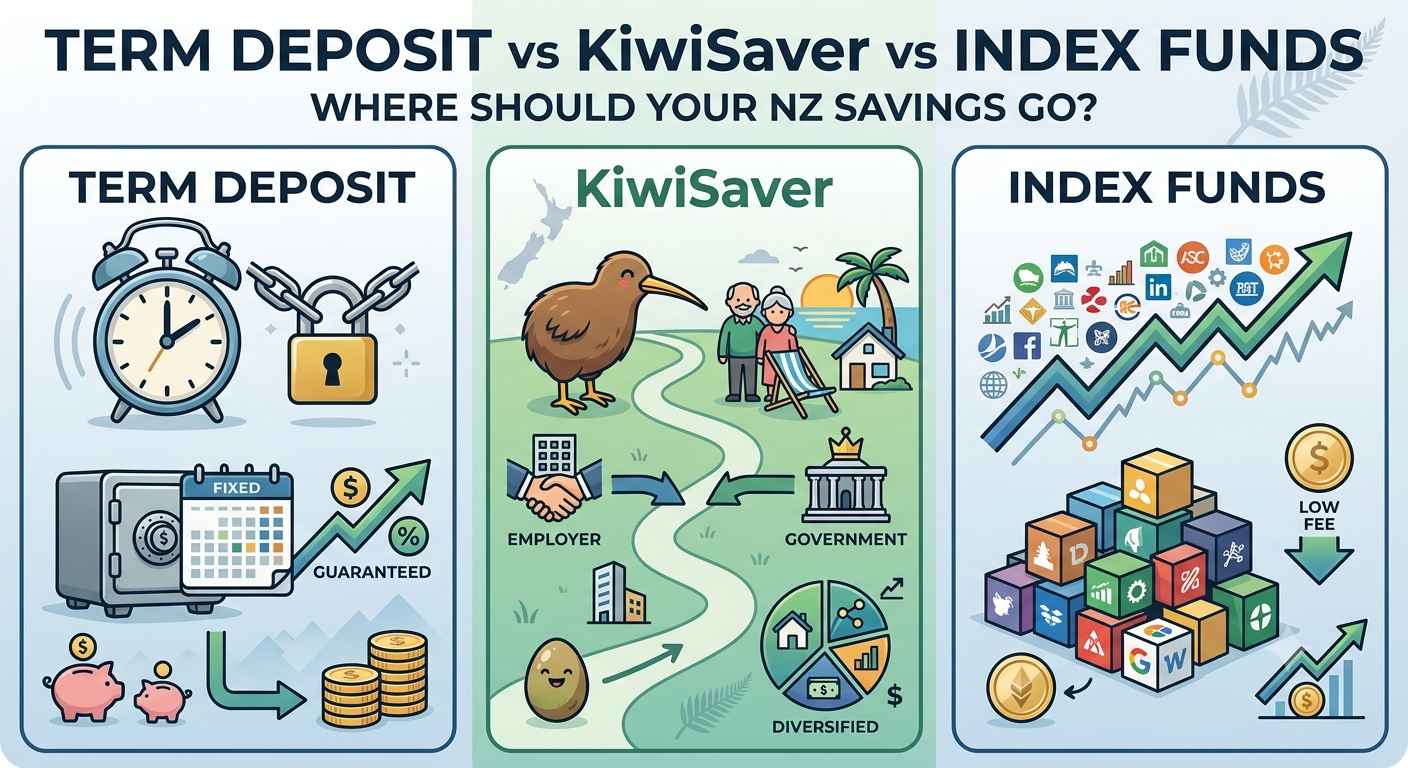
      Deciding between a Term Deposit vs KiwiSaver depends entirely on your financial timeline: term deposits are your undisputed safety net for short-term targets, whereas KiwiSaver is the ultimate engine for long-term wealth.

      If you are a self-employed Kiwi setting aside cash for a looming IRD provisional tax bill, a first-home buyer trying to hit a 20% deposit, or simply someone wanting to beat inflation, you are facing a genuine dilemma. Do you lock your money into a term deposit, maximise your KiwiSaver contributions, or invest in a low-cost index fund?

      When looking for the best way to save money in New Zealand in 2026 has to offer, there is no one-size-fits-all answer. Let’s run an honest, plain-English comparison across risk tolerance, liquidity, tax treatment, and long-term returns so you can make the right call for your wallet.

      1. Term Deposits: The Safe Harbour

      Think of a term deposit as a secure financial parking space. You hand your money to the bank for a set period (anywhere from 30 days to five years), and they guarantee you a fixed interest rate in return.

      For self-employed contractors, freelancers, and small business owners, term deposits are often the holy grail for managing provisional tax. If you owe the IRD $15,000 in six months under the standard uplift method, you absolutely cannot afford to put that money in the share market where it might suddenly drop in value. A 6-month term deposit ensures your capital is completely protected while earning a modest return before tax time rolls around.

      Current 2026 Rates & The Tax Catch

      Following the Reserve Bank (RBNZ) OCR adjustments over the last couple of years, term deposit rates in mid-2026 are sitting in a solid, albeit slightly cooler, range. You can generally expect around 3.90% to 4.00% for a 1-year term, and up to 4.75% to 4.90% if you are willing to lock your cash away for 4 to 5 years.

      However, the real killer for term deposits is the tax man. The interest you earn on a standard term deposit is classified as income and taxed at your Resident Withholding Tax (RWT) rate. Based on the 2026 tax brackets, if you earn over $180,000, your interest is taxed at a punishing 39%. A 4.5% return quickly shrinks to just 2.74% in your pocket. Even if you are in the 33% tax bracket (earning between $78,001 and $180,000), a massive chunk of your interest is eaten up by the IRD.

      Pro Tip: Always check if your bank offers a “PIE Term Deposit.” Portfolio Investment Entities (PIEs) cap your maximum tax rate (known as your Prescribed Investor Rate or PIR) at 28%, meaning middle-to-high earners get to keep significantly more of their interest.

      Pros and Cons of Term Deposits

      • Pros: 100% guaranteed return; zero market volatility; highly predictable for short-term goals like buying a car or paying an impending provisional tax bill.
      • Cons: Returns rarely outpace inflation in a meaningful way; your money is strictly locked away (banks will charge you break fees and reduce your interest if you desperately need the cash early); heavily taxed for middle-to-high income earners if you don’t use a PIE structure.

      2. KiwiSaver: The Wealth-Building Engine

      For most New Zealanders, KiwiSaver is the single most powerful financial tool in their arsenal. A common misconception is that it is just a savings account. It isn’t; it is a managed investment fund with built-in free money from the government and your employer.

      The 2026 KiwiSaver Rule Changes You Need to Know

      If you’ve been on autopilot with your KiwiSaver, you need to pay attention, because the rules changed significantly in April 2026.

      If you are employed, the minimum default contribution rate increased from 3% to 3.5%. You can now choose to contribute 3.5%, 4%, 6%, 8%, or 10% of your before-tax pay. The magic happens when your employer matches your contribution. By law, they must match your minimum 3.5% contribution (minus Employer Superannuation Contribution Tax, or ESCT).

      If you earn $80,000 a year, a 3.5% contribution is $2,800. Your employer throwing in another $2,800 (minus tax) is an immediate, risk-free return on your money that you literally cannot find anywhere else. As an added bonus from 2026, 16 and 17-year-old employees now also receive this employer match!

      The Government Contribution Updates

      On top of the employer match, the government chips in, though the rules have recently tightened. As of the 2025/2026 changes, the government now contributes 25 cents for every dollar you contribute, up to a maximum of $260.72 per year. To get this full amount, you need to contribute at least $1,042.86 between 1 July and 30 June.

      Crucial update: If you earn over $180,000 a year in taxable income, you are no longer eligible for this government top-up.

      The LVR Property Hurdle

      Under current RBNZ Loan-to-Value Ratio (LVR) restrictions, banks heavily favour borrowers who have a 20% deposit. For an $800,000 starter home in a major NZ city, that means saving a daunting $160,000. For most young Kiwis, scraping together that kind of cash while paying rent to a landlord or living with flatmates is nearly impossible without leveraging KiwiSaver’s compound growth and employer matches.

      Pros and Cons of KiwiSaver

      • Pros: Employer match (literally free money); annual government contribution for those earning under $180k; forces disciplined saving because you cannot touch it on a whim.
      • Cons: Completely locked in—you can only withdraw the funds for your first home purchase, extreme financial hardship, or when you reach age 65. If you voluntarily contribute 8% or 10%, your employer is still only legally required to match 3.5%.

      3. NZ Index Funds: The Flexible Powerhouse

      What if you are already contributing 3.5% to KiwiSaver to get the employer match, but you have spare cash left over each payday? Or what if you’re self-employed and want to build a retirement portfolio without locking it away until you are 65? This is where index funds shine.

      Platforms like Sharesies, InvestNow, and Kernel have democratized investing in NZ. Instead of trying to guess which individual company will perform well, an index fund allows you to buy a tiny slice of all the top companies in a market at once (like the NZX 50 in New Zealand or the S&P 500 in the US).

      Index funds offer the exact same long-term compound growth potential as a KiwiSaver Growth fund, but with one massive advantage: liquidity. You aren’t locked in until retirement. If you want to start a business in five years, upgrade the family home, or buy a boat, you can sell your index fund units and have the cash in your New Zealand bank account within a couple of business days.

      Furthermore, New Zealand index funds are heavily tax-advantaged because they are generally structured as PIEs. As mentioned earlier, the Prescribed Investor Rate (PIR) maxes out at 28%. If your regular income puts you in the 33% or 39% tax bracket, investing through a PIE index fund legally shields a portion of your wealth from the highest income tax rates.

      Pros and Cons of Index Funds

      • Pros: High historical long-term returns; entirely flexible and liquid (sell whenever you want); PIE tax advantages for higher earners; incredibly low management fees compared to actively managed funds.
      • Cons: Market volatility (your balance will inevitably drop during market corrections); requires immense emotional discipline not to panic-sell when the news is bad; no employer match or government top-ups.

      4. The Ultimate Showdown: The comparison between banks and managed funds

      To win the debate between these two savings vehicles, you need to see how they stack up side-by-side. Use this table to understand the core differences at a glance.

      FeatureTerm DepositKiwiSaverIndex Funds (via Platforms)
      LiquidityLow (locked for a set term)Very Low (locked to age 65 or first home)High (can sell and withdraw in 2-3 business days)
      Tax RateUp to 39% RWT (unless you use a PIE Term Deposit)Capped at 28% PIRCapped at 28% PIR
      Expected ReturnModest (roughly 3.90% – 4.90% in 2026)High (if in a Growth or Aggressive fund)High (based on long-term historical averages)
      Lock-in Period1 month to 5 yearsDecades (unless buying a first home)None
      Risk LevelExtremely Low (capital is guaranteed)Varies wildly by fund type (Conservative to Growth)Moderate to High (dependent on the share market)

      5. The $10,000 Worked Example

      Let’s look at hard numbers using real NZ dollars. Imagine you have a $10,000 lump sum right now. You are already getting your KiwiSaver employer match through your day job, so this $10,000 is purely extra savings. You intend to leave it alone for 10 years. (Note: These are projections for educational purposes, not guaranteed returns, and ignore inflation).

      Scenario A: The Term Deposit

      You roll your $10,000 into a new term deposit every single year, averaging a 4.5% interest rate over the decade. You earn over $78,000, placing you in the 33% tax bracket, so your after-tax return is roughly 3.01%.

      • Balance after 10 years: $13,450
      • Total Profit: $3,450

      Scenario B: KiwiSaver / Index Fund (Growth Asset)

      You put that exact same $10,000 into a low-fee Growth KiwiSaver fund or an S&P 500 Index Fund. Let’s assume the share market returns a conservative historical average of 7.5% per year after management fees. Taxed at the maximum 28% PIR, your net return is 5.4%.

      • Balance after 10 years: $16,920
      • Total Profit: $6,920

      The Takeaway: By investing in growth assets (like a KiwiSaver or Index Fund) rather than leaving it in the bank, you practically double your profit over a decade. The only operational difference between KiwiSaver and the Index Fund in this scenario is that the Index Fund lets you withdraw the $16,920 on a random Tuesday if your car breaks down or you decide to launch a business, whereas the KiwiSaver money remains firmly locked away.

      6. The Verdict: Where Should Your Money Go?

      Who should prioritise Term Deposits?

      • The Provisional Taxpayer: If you are self-employed and need to pay the IRD in 3 to 9 months, do not risk this cash in the share market. Use a term deposit to ensure the money is there when terminal tax dates hit.
      • The Imminent Buyer: If you are buying a house, renovating, or buying a car within the next 12 to 24 months, capital preservation is your absolute priority.

      Who should boost KiwiSaver?

      • The First Home Buyer (3+ years out): If you are saving for a house deposit and have a few years up your sleeve, cranking your KiwiSaver contribution up to 8% or 10% is a fantastic way to force yourself to save. You won’t be tempted to spend it on a Hire Purchase TV or a holiday.
      • The Employee on the Default Rate: Never contribute less than the default 3.5%. That employer match is free money. If your workplace offers a higher matched rate (for example, they agree to match up to 5%), increase your contribution immediately to capture it.

      Who should choose Index Funds?

      • The Mid-Term Dreamer: If you want to build serious wealth but might want to access it before you turn 65 for a career break, your kids’ education, or starting a business, index funds hit the absolute sweet spot.
      • The Maximiser: Once you have secured your employer’s maximum KiwiSaver match and the government contribution (if eligible), redirecting extra savings into platforms like Sharesies or InvestNow gives you total control over your financial independence without throwing away the key to the vault.

      Ready to see exactly how your money could work for you?

      Your savings strategy doesn’t have to be an all-or-nothing game. The smartest Kiwis use a hybrid approach: term deposits for short-term tax bills and safety nets, KiwiSaver for the free employer matches, and index funds for accessible wealth building.

      📊 Run your own numbers:

      • Term Deposit Calculator: Use our free tool to reveal your true after-tax returns on short-term savings and ensure the IRD isn’t eating your profits.
      • KiwiSaver Projection Calculator: Map out the exact timeline for your first home deposit or retirement nest egg with compound interest factored in.

      Better yet, try both and compare your options side-by-side to make the most informed decision for your financial future!

      Frequently Asked Questions

      Can you have all three options at once?

      Absolutely, and it is highly recommended by financial experts! A common strategy for self-employed Kiwis is to hold provisional tax in a short term deposit, contribute enough voluntarily to KiwiSaver to grab the $260.72 government contribution, and drip-feed any leftover monthly profits into an index fund for liquid wealth.

      Is it safe to put my provisional tax savings in an index fund?

      No. Provisional tax is a known, short-term liability. Index funds can easily drop by 10% or 20% in a given year. If the market crashes right before your IRD bill is due, you will be forced to sell your investments at a loss and may not have enough cash to cover your tax obligations. Always use high-interest savings accounts or term deposits for tax money.

      How do I switch my KiwiSaver fund type from Conservative to Growth?

      It is incredibly easy, and you don’t need a lawyer or financial adviser. Simply log into your KiwiSaver provider’s app or website (or your online banking if your KiwiSaver is with your main bank) and look for the “Change Fund” option. It usually takes less than five minutes and processes within a few business days.

      What happens if my KiwiSaver provider or index fund platform goes bust?

      In New Zealand, investments held by KiwiSaver providers and major investment platforms (like Sharesies, Kernel, or InvestNow) are held in a separate, independent trust account by a custodian. If the company operating the platform goes bankrupt, your money and your shares are ring-fenced and completely safe from the company’s creditors.

      Are term deposit rates going to drop further in 2026?

      Interest rates are directly tied to the RBNZ Official Cash Rate. With the OCR having stabilized after peaking in recent years, banks have adjusted their rates downward slightly. While nobody has a crystal ball, locking in a 3-year or 4-year term deposit now guarantees your rate even if the RBNZ continues to drop the OCR to stimulate the broader New Zealand economy.

      Disclaimer: This is general information, not personalized financial advice. This article provides general information and educational content only. We are not registered financial advisers. Always speak to a licensed financial advice provider before making major changes to your KiwiSaver fund, investment portfolio, or mortgage strategy.