
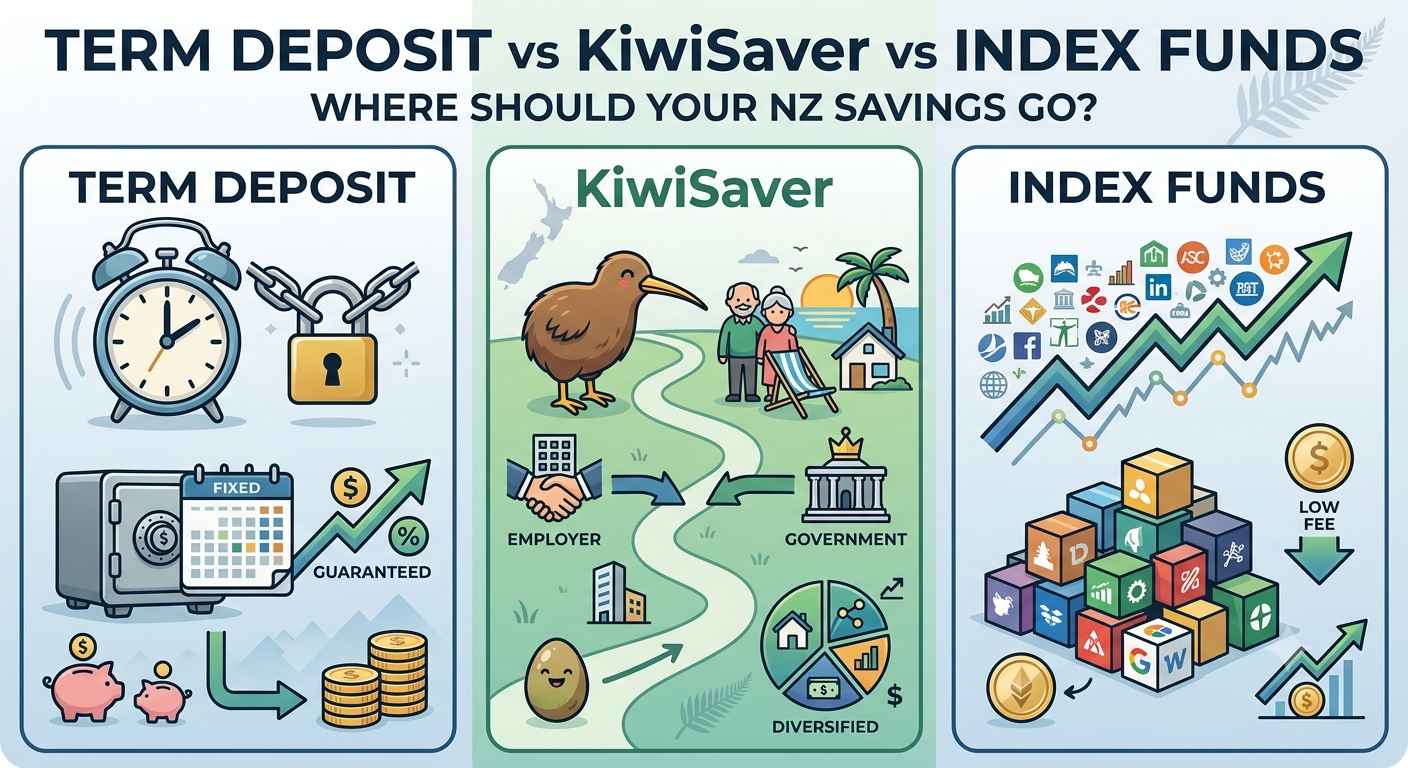
Deciding between a Term Deposit vs KiwiSaver depends entirely on your financial timeline: term deposits are your undisputed safety net for short-term targets, whereas KiwiSaver is the ultimate engine for long-term wealth.
If you are a self-employed Kiwi setting aside cash for a looming IRD provisional tax bill, a first-home buyer trying to hit a 20% deposit, or simply someone wanting to beat inflation, you are facing a genuine dilemma. Do you lock your money into a term deposit, maximise your KiwiSaver contributions, or invest in a low-cost index fund?
When looking for the best way to save money in New Zealand in 2026 has to offer, there is no one-size-fits-all answer. Let’s run an honest, plain-English comparison across risk tolerance, liquidity, tax treatment, and long-term returns so you can make the right call for your wallet.
1. Term Deposits: The Safe Harbour
Think of a term deposit as a secure financial parking space. You hand your money to the bank for a set period (anywhere from 30 days to five years), and they guarantee you a fixed interest rate in return.
For self-employed contractors, freelancers, and small business owners, term deposits are often the holy grail for managing provisional tax. If you owe the IRD $15,000 in six months under the standard uplift method, you absolutely cannot afford to put that money in the share market where it might suddenly drop in value. A 6-month term deposit ensures your capital is completely protected while earning a modest return before tax time rolls around.
Current 2026 Rates & The Tax Catch
Following the Reserve Bank (RBNZ) OCR adjustments over the last couple of years, term deposit rates in mid-2026 are sitting in a solid, albeit slightly cooler, range. You can generally expect around 3.90% to 4.00% for a 1-year term, and up to 4.75% to 4.90% if you are willing to lock your cash away for 4 to 5 years.
However, the real killer for term deposits is the tax man. The interest you earn on a standard term deposit is classified as income and taxed at your Resident Withholding Tax (RWT) rate. Based on the 2026 tax brackets, if you earn over $180,000, your interest is taxed at a punishing 39%. A 4.5% return quickly shrinks to just 2.74% in your pocket. Even if you are in the 33% tax bracket (earning between $78,001 and $180,000), a massive chunk of your interest is eaten up by the IRD.
Pro Tip: Always check if your bank offers a “PIE Term Deposit.” Portfolio Investment Entities (PIEs) cap your maximum tax rate (known as your Prescribed Investor Rate or PIR) at 28%, meaning middle-to-high earners get to keep significantly more of their interest.
Pros and Cons of Term Deposits
- Pros: 100% guaranteed return; zero market volatility; highly predictable for short-term goals like buying a car or paying an impending provisional tax bill.
- Cons: Returns rarely outpace inflation in a meaningful way; your money is strictly locked away (banks will charge you break fees and reduce your interest if you desperately need the cash early); heavily taxed for middle-to-high income earners if you don’t use a PIE structure.
2. KiwiSaver: The Wealth-Building Engine
For most New Zealanders, KiwiSaver is the single most powerful financial tool in their arsenal. A common misconception is that it is just a savings account. It isn’t; it is a managed investment fund with built-in free money from the government and your employer.
The 2026 KiwiSaver Rule Changes You Need to Know
If you’ve been on autopilot with your KiwiSaver, you need to pay attention, because the rules changed significantly in April 2026.
If you are employed, the minimum default contribution rate increased from 3% to 3.5%. You can now choose to contribute 3.5%, 4%, 6%, 8%, or 10% of your before-tax pay. The magic happens when your employer matches your contribution. By law, they must match your minimum 3.5% contribution (minus Employer Superannuation Contribution Tax, or ESCT).
If you earn $80,000 a year, a 3.5% contribution is $2,800. Your employer throwing in another $2,800 (minus tax) is an immediate, risk-free return on your money that you literally cannot find anywhere else. As an added bonus from 2026, 16 and 17-year-old employees now also receive this employer match!
The Government Contribution Updates
On top of the employer match, the government chips in, though the rules have recently tightened. As of the 2025/2026 changes, the government now contributes 25 cents for every dollar you contribute, up to a maximum of $260.72 per year. To get this full amount, you need to contribute at least $1,042.86 between 1 July and 30 June.
Crucial update: If you earn over $180,000 a year in taxable income, you are no longer eligible for this government top-up.
The LVR Property Hurdle
Under current RBNZ Loan-to-Value Ratio (LVR) restrictions, banks heavily favour borrowers who have a 20% deposit. For an $800,000 starter home in a major NZ city, that means saving a daunting $160,000. For most young Kiwis, scraping together that kind of cash while paying rent to a landlord or living with flatmates is nearly impossible without leveraging KiwiSaver’s compound growth and employer matches.
Pros and Cons of KiwiSaver
- Pros: Employer match (literally free money); annual government contribution for those earning under $180k; forces disciplined saving because you cannot touch it on a whim.
- Cons: Completely locked in—you can only withdraw the funds for your first home purchase, extreme financial hardship, or when you reach age 65. If you voluntarily contribute 8% or 10%, your employer is still only legally required to match 3.5%.
3. NZ Index Funds: The Flexible Powerhouse
What if you are already contributing 3.5% to KiwiSaver to get the employer match, but you have spare cash left over each payday? Or what if you’re self-employed and want to build a retirement portfolio without locking it away until you are 65? This is where index funds shine.
Platforms like Sharesies, InvestNow, and Kernel have democratized investing in NZ. Instead of trying to guess which individual company will perform well, an index fund allows you to buy a tiny slice of all the top companies in a market at once (like the NZX 50 in New Zealand or the S&P 500 in the US).
Index funds offer the exact same long-term compound growth potential as a KiwiSaver Growth fund, but with one massive advantage: liquidity. You aren’t locked in until retirement. If you want to start a business in five years, upgrade the family home, or buy a boat, you can sell your index fund units and have the cash in your New Zealand bank account within a couple of business days.
Furthermore, New Zealand index funds are heavily tax-advantaged because they are generally structured as PIEs. As mentioned earlier, the Prescribed Investor Rate (PIR) maxes out at 28%. If your regular income puts you in the 33% or 39% tax bracket, investing through a PIE index fund legally shields a portion of your wealth from the highest income tax rates.
Pros and Cons of Index Funds
- Pros: High historical long-term returns; entirely flexible and liquid (sell whenever you want); PIE tax advantages for higher earners; incredibly low management fees compared to actively managed funds.
- Cons: Market volatility (your balance will inevitably drop during market corrections); requires immense emotional discipline not to panic-sell when the news is bad; no employer match or government top-ups.
4. The Ultimate Showdown: The comparison between banks and managed funds
To win the debate between these two savings vehicles, you need to see how they stack up side-by-side. Use this table to understand the core differences at a glance.
| Feature | Term Deposit | KiwiSaver | Index Funds (via Platforms) |
| Liquidity | Low (locked for a set term) | Very Low (locked to age 65 or first home) | High (can sell and withdraw in 2-3 business days) |
| Tax Rate | Up to 39% RWT (unless you use a PIE Term Deposit) | Capped at 28% PIR | Capped at 28% PIR |
| Expected Return | Modest (roughly 3.90% – 4.90% in 2026) | High (if in a Growth or Aggressive fund) | High (based on long-term historical averages) |
| Lock-in Period | 1 month to 5 years | Decades (unless buying a first home) | None |
| Risk Level | Extremely Low (capital is guaranteed) | Varies wildly by fund type (Conservative to Growth) | Moderate to High (dependent on the share market) |
5. The $10,000 Worked Example
Let’s look at hard numbers using real NZ dollars. Imagine you have a $10,000 lump sum right now. You are already getting your KiwiSaver employer match through your day job, so this $10,000 is purely extra savings. You intend to leave it alone for 10 years. (Note: These are projections for educational purposes, not guaranteed returns, and ignore inflation).
Scenario A: The Term Deposit
You roll your $10,000 into a new term deposit every single year, averaging a 4.5% interest rate over the decade. You earn over $78,000, placing you in the 33% tax bracket, so your after-tax return is roughly 3.01%.
- Balance after 10 years: $13,450
- Total Profit: $3,450
Scenario B: KiwiSaver / Index Fund (Growth Asset)
You put that exact same $10,000 into a low-fee Growth KiwiSaver fund or an S&P 500 Index Fund. Let’s assume the share market returns a conservative historical average of 7.5% per year after management fees. Taxed at the maximum 28% PIR, your net return is 5.4%.
- Balance after 10 years: $16,920
- Total Profit: $6,920
The Takeaway: By investing in growth assets (like a KiwiSaver or Index Fund) rather than leaving it in the bank, you practically double your profit over a decade. The only operational difference between KiwiSaver and the Index Fund in this scenario is that the Index Fund lets you withdraw the $16,920 on a random Tuesday if your car breaks down or you decide to launch a business, whereas the KiwiSaver money remains firmly locked away.
6. The Verdict: Where Should Your Money Go?
Who should prioritise Term Deposits?
- The Provisional Taxpayer: If you are self-employed and need to pay the IRD in 3 to 9 months, do not risk this cash in the share market. Use a term deposit to ensure the money is there when terminal tax dates hit.
- The Imminent Buyer: If you are buying a house, renovating, or buying a car within the next 12 to 24 months, capital preservation is your absolute priority.
Who should boost KiwiSaver?
- The First Home Buyer (3+ years out): If you are saving for a house deposit and have a few years up your sleeve, cranking your KiwiSaver contribution up to 8% or 10% is a fantastic way to force yourself to save. You won’t be tempted to spend it on a Hire Purchase TV or a holiday.
- The Employee on the Default Rate: Never contribute less than the default 3.5%. That employer match is free money. If your workplace offers a higher matched rate (for example, they agree to match up to 5%), increase your contribution immediately to capture it.
Who should choose Index Funds?
- The Mid-Term Dreamer: If you want to build serious wealth but might want to access it before you turn 65 for a career break, your kids’ education, or starting a business, index funds hit the absolute sweet spot.
- The Maximiser: Once you have secured your employer’s maximum KiwiSaver match and the government contribution (if eligible), redirecting extra savings into platforms like Sharesies or InvestNow gives you total control over your financial independence without throwing away the key to the vault.
Ready to see exactly how your money could work for you?
Your savings strategy doesn’t have to be an all-or-nothing game. The smartest Kiwis use a hybrid approach: term deposits for short-term tax bills and safety nets, KiwiSaver for the free employer matches, and index funds for accessible wealth building.
📊 Run your own numbers:
- Term Deposit Calculator: Use our free tool to reveal your true after-tax returns on short-term savings and ensure the IRD isn’t eating your profits.
- KiwiSaver Projection Calculator: Map out the exact timeline for your first home deposit or retirement nest egg with compound interest factored in.
Better yet, try both and compare your options side-by-side to make the most informed decision for your financial future!
Frequently Asked Questions
Can you have all three options at once?
Absolutely, and it is highly recommended by financial experts! A common strategy for self-employed Kiwis is to hold provisional tax in a short term deposit, contribute enough voluntarily to KiwiSaver to grab the $260.72 government contribution, and drip-feed any leftover monthly profits into an index fund for liquid wealth.
Is it safe to put my provisional tax savings in an index fund?
No. Provisional tax is a known, short-term liability. Index funds can easily drop by 10% or 20% in a given year. If the market crashes right before your IRD bill is due, you will be forced to sell your investments at a loss and may not have enough cash to cover your tax obligations. Always use high-interest savings accounts or term deposits for tax money.
How do I switch my KiwiSaver fund type from Conservative to Growth?
It is incredibly easy, and you don’t need a lawyer or financial adviser. Simply log into your KiwiSaver provider’s app or website (or your online banking if your KiwiSaver is with your main bank) and look for the “Change Fund” option. It usually takes less than five minutes and processes within a few business days.
What happens if my KiwiSaver provider or index fund platform goes bust?
In New Zealand, investments held by KiwiSaver providers and major investment platforms (like Sharesies, Kernel, or InvestNow) are held in a separate, independent trust account by a custodian. If the company operating the platform goes bankrupt, your money and your shares are ring-fenced and completely safe from the company’s creditors.
Are term deposit rates going to drop further in 2026?
Interest rates are directly tied to the RBNZ Official Cash Rate. With the OCR having stabilized after peaking in recent years, banks have adjusted their rates downward slightly. While nobody has a crystal ball, locking in a 3-year or 4-year term deposit now guarantees your rate even if the RBNZ continues to drop the OCR to stimulate the broader New Zealand economy.
Disclaimer: This is general information, not personalized financial advice. This article provides general information and educational content only. We are not registered financial advisers. Always speak to a licensed financial advice provider before making major changes to your KiwiSaver fund, investment portfolio, or mortgage strategy.
Leave a Reply