
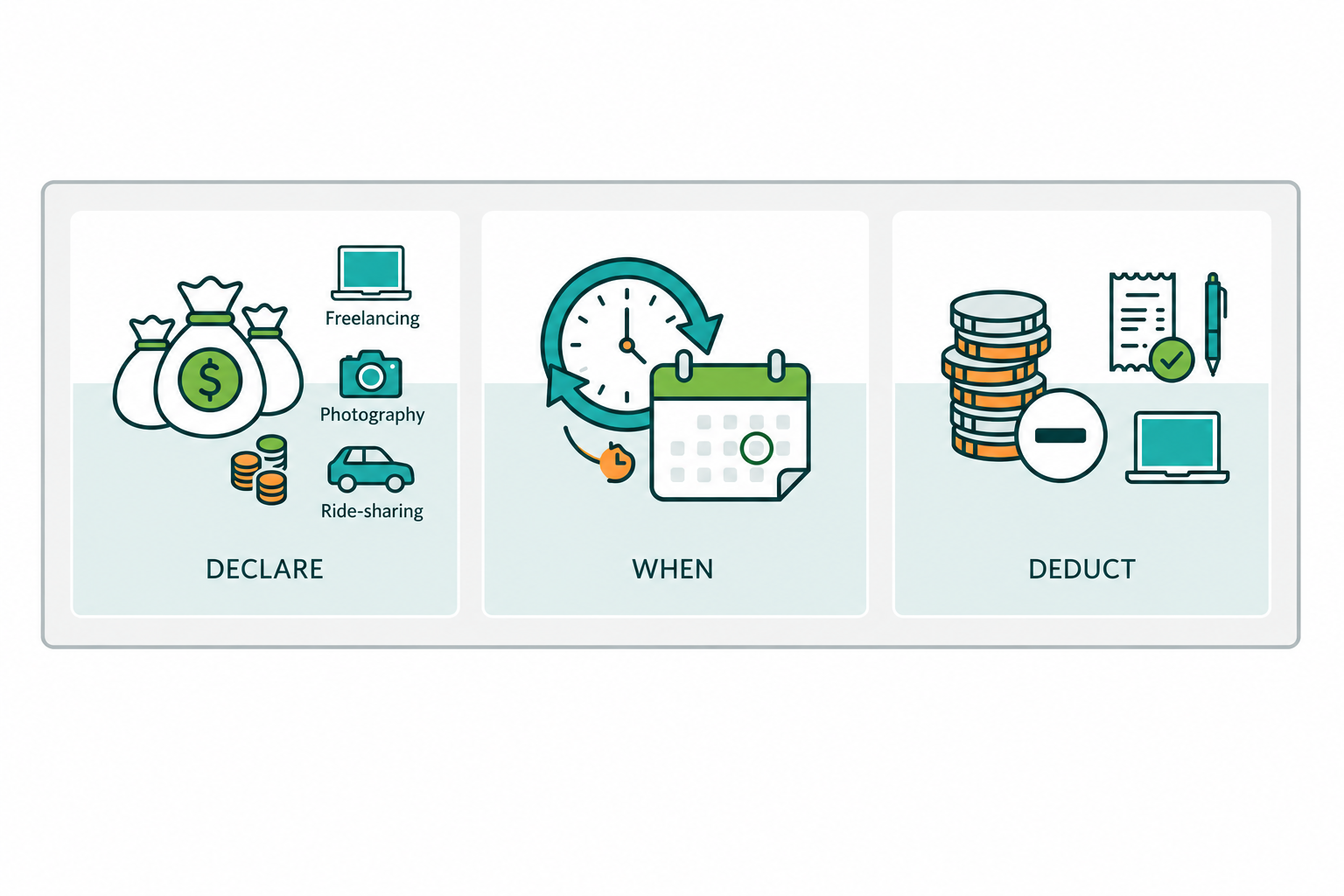
You’re leaving yourself wide open to a massive tax bill and avoidable penalties if you’re quietly pocketing cash from your side hustle while assuming the IRD isn’t watching. With the cost of living climbing in Aotearoa, and RBNZ LVR restrictions meaning you still generally need a 20% deposit for a home, every extra dollar counts—but you need to make sure the taxman gets his legally required cut before you spend it.
The Side-Hustle Tax Confusion in NZ (And Why IRD Is Watching)
New Zealand has a surging side-hustle economy. Whether you’re delivering Uber Eats on the weekends, renting out a sleepout on Airbnb, freelancing as a graphic designer, or flipping vintage clothes on TradeMe, Kiwis are working harder than ever to get ahead and build alternative income streams.
Yet, most people earning extra income are completely in the dark about their tax obligations. The common myth is that if your side gig is small enough, it simply flies under the radar. But here is the reality for the 2026/2027 tax year: Inland Revenue (IRD) has more data-matching power than ever before. Thanks to modernized systems and new reporting laws, the IRD receives automatic data from domestic banks, property platforms, and gig economy apps. Undeclared income is much harder to hide, and much easier to get caught out on.
This comprehensive guide is going to break down exactly what you need to declare, how to claim legitimate business expenses so you pay less tax legally, and what the latest platform economy rules mean for your side hustle.
Is All Side-Hustle Income Taxable?
The short answer is: mostly, yes. In New Zealand, if you are engaging in an activity with the intention of making a profit, the IRD considers the money you generate from it to be taxable income.
However, there is an exception for the occasional sale of private domestic assets. If you are just doing a spring clean, clearing out your garage, and selling your old surfboard, a spare fridge, or a pile of your own worn clothes on Facebook Marketplace or TradeMe, that money is entirely tax-free. You are simply recovering a fraction of the personal costs for items you already owned.
But the moment you start going to op-shops to buy items with the intention of reselling them online for a profit, you cross the line. You are no longer selling private assets; you are trading. That makes your activity a taxable venture.
Hobby vs. Business: How IRD Distinguishes Them
This is where a lot of everyday Kiwis get tripped up. You might think selling your homemade candles, baking sourdough for neighbors, or weekend woodworking is just a “hobby,” but the IRD might view it as an unregistered business.
The IRD doesn’t care what you call your activity. Instead, they look at the inherent nature of what you are doing. Your side hustle is legally considered a business (and therefore taxable) if it meets several of these criteria:
- Intention to make a profit: You price your goods or services specifically to make money, rather than just asking people to cover the cost of your raw materials.
- Regularity: You are doing it consistently—such as selling at the Sunday markets every weekend, rather than just having one stall a year.
- Organization: You keep financial records, have a separate bank account, run a dedicated social media page to attract customers, or have a logo.
- Time and effort: You invest a significant amount of your time into producing your goods or marketing to find clients.
If you are just knitting scarves for your flatmates and charging them exactly what the wool cost you, it is a hobby. If you set up an Instagram shop to sell those same scarves at a 50% markup, congratulations—you are now in business and owe tax on your net profits.
Quick Comparison: Hobby vs. Business
| Feature | Hobby (Tax-Free) | Business (Taxable) |
| Pricing | Covers cost of materials only | Marked up to generate a profit |
| Frequency | Rare, one-off, or highly sporadic | Regular, ongoing, structured |
| Marketing | None, or word-of-mouth to friends | Active social media, website, paid ads |
| Record Keeping | None | Tracking sales, keeping receipts, invoicing |
How to Declare Side Income: The IR3 Explained
If you have a standard 9-to-5 job, your employer takes care of your tax automatically via the PAYE (Pay As You Earn) system. But your side-hustle income isn’t taxed at the source. Because you are essentially operating as a “sole trader,” the responsibility of declaring and paying the tax falls entirely on your shoulders.
To declare this extra income, you must file an IR3 Individual Tax Return through your myIR online portal at the end of the tax year.
- The New Zealand tax year runs from April 1 to March 31.
- If you manage your own taxes, your IR3 return is due by July 7 each year.
- If you use a registered tax agent or accountant, you usually get an extension until March 31 of the following year.
Beware the Provisional Tax Trap
If your side hustle is highly successful and you end up owing the IRD more than $5,000 in end-of-year tax on your IR3, you will automatically be pushed into the Provisional Tax regime for the following year.
This means instead of paying one lump sum at the end of the year, the IRD will require you to pay your estimated taxes in advance, usually in three instalments (August, January, and May). This catches many side-hustlers off guard, as they suddenly have to pay last year’s tax bill and their first provisional instalment for the current year at the same time.
How Your Tax is Calculated for 2026/2027
New Zealand has a progressive tax system. This means you don’t pay one flat rate on everything you earn. Instead, your side hustle income is added on top of your main PAYE salary to determine your final, highest tax bracket (known as your marginal tax rate).
Here are the confirmed NZ Tax Brackets for the 2026/2027 tax year:
- $0 – $15,600: 10.5%
- $15,601 – $53,500: 17.5%
- $53,501 – $78,100: 30%
- $78,101 – $180,000: 33%
- $180,001 and over: 39%
The Hidden Costs: ACC and Student Loans
When budgeting for your tax bill, income tax is only part of the equation. You also need to account for the ACC Earner’s Levy. From April 1, 2026, the ACC levy is 1.75% on your taxable income (up to a maximum threshold of $156,641).
Furthermore, if you have a New Zealand Student Loan, you are required to pay a 12% repayment on every dollar you earn over the annual repayment threshold (which sits at $24,128). Because your primary job likely already pushes you past this threshold, every single dollar of your side hustle profit will trigger a 12% deduction.
Real NZD Example: Calculating Your Bill
Let’s look at how the math actually works if you have a full-time job and a side hustle.
- Your Day Job Salary: $70,000 (Your employer handles PAYE, ACC, and Student Loan on this).
- Your Side Hustle Net Profit: $10,000 (Money left over after your expenses).
- Your Total Annual Income: $80,000.
Because your $70,000 salary already fills up the lower tax brackets, your $10,000 side-hustle money sits entirely at the top.
- Income Tax: $8,100 of your profit sits in the 30% bracket (taking you from $70k to $78.1k) which equals $2,430. The remaining $1,900 pushes into the 33% bracket (from $78.1k to $80k) which equals $627. Total Income Tax: $3,057.
- ACC Levy (1.75%): 1.75% of your $10,000 profit equals $175.
- Student Loan (12%): If you have a loan, 12% of the $10,000 profit equals $1,200.
Total Bill to IRD: $4,432.
In this scenario, you need to set aside nearly 45% of your side hustle profits just to stay compliant with the IRD. This is why having a separate bank account and putting a percentage away every time you get paid is absolutely vital.
Legitimate Deductions You Can Claim
You only pay tax on your net profit, not your total gross revenue. To legally pay less tax, you need to claim every single legitimate business expense. The golden rule is: if you spent money to make money, you can usually deduct it.
Common side-hustle deductions include:
- Equipment and Tools: Laptops, cameras, power tools, or specialized gear. Note: If a single item costs more than $1,000, you cannot deduct the entire cost in the year you bought it. You must capitalize it and claim “depreciation” over its useful life (for example, depreciating a laptop at 50% diminishing value).
- Software and Subscriptions: Your Adobe Creative Cloud, Xero or Hnry accounting fees, Microsoft 365, web hosting, or domain names.
- Mobile Phone & Internet: If you use your personal phone for business, you can claim a percentage. If you use it 50% for client calls and 50% for personal scrolling, you can deduct 50% of your monthly bill.
- Vehicle Mileage: If you use your personal car to drive to clients, pick up supplies, or make deliveries, you can claim vehicle expenses. The easiest method is using the IRD’s mileage rate (which is adjusted annually and sits around $0.95 to $1.04 per kilometre). Crucial rule: You must keep a strict logbook for 90 days recording every trip to establish your business usage percentage. That logbook is then valid for three years.
- Bank Fees & Interest: Monthly account fees on business accounts, or interest on a loan you took out specifically to fund your side hustle.
The Home Office Deduction: Getting the Math Right
If you run your side hustle from your rented house or mortgaged home, you can claim a proportion of your household expenses. This includes rent or mortgage interest (not principal), power, internet, home insurance, and rates.
You calculate this based on the floor area your workspace takes up compared to the entire house.
Real NZD Example:
You rent a 100-square-metre flat in Auckland. You use a 10-square-metre spare bedroom exclusively as your freelance graphic design office. Your workspace is exactly 10% of the house.
- Total annual rent: $30,000
- Total annual power: $2,500
- Total annual internet: $1,000
- Total household costs: $33,500
Because your office takes up 10% of the home, you can legally deduct 10% of those costs ($3,350) from your side hustle revenue. This instantly lowers your taxable profit by over three grand, keeping significantly more cash in your pocket at tax time.
(Note: If you work from the dining room table that is also used for eating, you cannot claim the whole room. You must apportion the claim based on the hours the space is actually used for business versus personal living).
The GST Threshold: When Do You Need to Register?
Most casual side hustlers do not need to worry about Goods and Services Tax (GST) when they first start out. You are only legally required to register for GST if your side hustle revenue (your total sales before expenses) exceeds $60,000 in any 12-month period.
Notice that this is a rolling 12-month period, not a tax year. If you hit $60,000 between October and the following September, you must register immediately.
If you are earning $20,000 a year doing weekend photography, you do not need to register. You do not add 15% GST to your client invoices, but on the flip side, you cannot claim back the GST on the expensive camera lenses you buy.
However, if your hustle scales up and you cross that $60k mark, registration is mandatory. Once registered, you must file regular GST returns (usually two-monthly or six-monthly), charge 15% on your goods and services, and you can finally claim back the 15% GST on your business expenses.
Platform Income: The Rules for Uber, Airbnb, Etsy, and Fiverr
If your side hustle relies on digital platforms, the rules have tightened dramatically. In April 2024, the NZ Government introduced the “App Tax” for online marketplaces providing short-stay accommodation (Airbnb, Bookabach) or ride-sharing and delivery services (Uber, Uber Eats).
Here is exactly how this operates for 2026/2027:
- The 15% Collection: Even if your side hustle makes only $5,000 a year (way under the $60,000 GST threshold), platforms like Airbnb and Uber are legally required to collect 15% GST on the services you provide and pay it directly to the IRD.
- The 8.5% Flat-Rate Credit: Because you aren’t personally GST-registered and can’t claim back GST on your expenses (like petrol or cleaning supplies), the platform passes an 8.5% “flat-rate credit” back to you to compensate.
- Your IR3 Obligation: You still need to declare your net income (the money that actually hits your bank account, including the 8.5% credit) on your end-of-year IR3 and pay standard income tax on it.
For global freelance platforms like Etsy, Upwork, or Fiverr, you are treated as a standard sole trader. Because you are usually paid in USD or another foreign currency, you must convert your earnings into NZD before declaring them. You are allowed to deduct the heavy platform fees and the currency conversion costs as legitimate business expenses on your tax return.
The $200 Earner Exemption: What It Actually Means
A common piece of bad advice thrown around Kiwi breakrooms is, “If you earn under a couple hundred bucks, it’s totally tax-free.” This is a dangerous misunderstanding of the IRD’s $200 tolerance rule.
If your total untaxed income for the entire tax year is under $200, the IRD essentially will not chase you for it. If that $200 is your only undeclared income, you do not have to file an IR3 return.
Warning: This is a $200 limit per year, not per week or per job. If you mow your neighbour’s lawn once in December for $150 and that is the only side money you make all year across any activity, you’re fine. But if you mow lawns every month and make $1,800 a year, you must declare every single dollar. There is no “$200 tax-free bracket” that you can deduct from your $1,800 total. You owe tax on the whole lot.
Record Keeping: How to Protect Yourself in 2026
By law, you must keep all of your business and side-hustle records for seven years. If the IRD decides to audit you, they will want proof of every expense you claimed.
This includes:
- Bank statements
- Invoices you sent to clients
- Receipts for every business expense
- Your vehicle logbook
- Home office square-meterage calculations
In 2026, you do not need shoeboxes full of fading thermal receipts. Keeping digital copies is perfectly acceptable and preferred by the IRD. Get into the habit of snapping a photo of your receipt on your phone and saving it to a dedicated Google Drive folder. Alternatively, using modern accounting software like Xero, or a purpose-built sole-trader tax service like Hnry, can automate your invoicing, expense tracking, and tax withholding, saving you hours of intense stress come July 7.
Frequently Asked Questions
Can I offset side-hustle losses against my PAYE salary?
Yes, in most general cases. If you operate as a sole trader and your side hustle makes a loss in its first year (for example, you spent $5,000 on tools and marketing but only made $2,000 in sales), that $3,000 loss can usually be offset against your main PAYE salary on your IR3. This effectively lowers your total taxable income, which can result in a welcome tax refund from the IRD.
Do I need a separate bank account for my side hustle?
While it isn’t legally mandatory if you are operating as a sole trader, it is highly, highly recommended. Mixing your personal supermarket shopping with your client income is an accounting nightmare. Set up a free, fee-free secondary transaction account with your bank and run all side hustle income and expenses through it. It takes five minutes and is the best thing you can do for your sanity.
I’m already in the top tax bracket (39%); is a side hustle even worth it?
If your primary salary is over $180,000, every dollar of profit from your side hustle will be taxed at 39% (plus the 1.75% ACC levy). While handing over 40+ cents on every dollar hurts, you are still taking home nearly 60 cents of pure profit you wouldn’t have had otherwise. It comes down to how much you value your free time—if the hustle is scalable, passive, or something you genuinely enjoy, it is still accelerating your wealth generation.
Do I get government KiwiSaver contributions on my side hustle?
Because side-hustle sole trader income is not subject to automatic PAYE KiwiSaver deductions, you aren’t automatically contributing. If you want to claim the government’s maximum annual top-up of $260.72 (as of the 2025/2026 changes), you will need to make sure you voluntarily contribute at least $521.43 to your KiwiSaver provider directly before the end of June each year.
What if I haven’t declared side hustle income for the last few years?
Don’t panic, but don’t ignore it hoping it will go away. The IRD looks much more favourably upon taxpayers who make a “voluntary disclosure” than those they catch via an audit. Contact the IRD (or hire a registered accountant to act on your behalf) to declare your past income. You will have to pay the back taxes and likely some interest, but a voluntary disclosure often heavily reduces or completely eliminates shortfall penalty fines.
Stay Compliant and Keep Growing
A side hustle is one of the best ways to accelerate your financial goals in New Zealand—whether that is crushing your student loan, aggressively bumping up your KiwiSaver balance, or building a house deposit in a tough market.
Just remember to treat it like a real business from day one. Track your expenses meticulously, set aside roughly 30% to 40% of your net profits in a high-interest savings account for the inevitable tax bill, and ensure you file your IR3 on time.
Want to know exactly how much you need to stash away for the taxman? Run your side hustle earnings through our free calculators below to take the guesswork out of your IRD bill.”
Secondary Tax Calculator | NZ GST Calculator
Disclaimer: This is general information, not personalized financial advice. Tax laws can be complex and subject to change. Always consult a registered accountant or tax agent regarding your specific financial situation.
Leave a Reply