
You’re leaving money on the table if your savings are sitting in a standard transaction account while NZ interest rates are hovering around 5-6%, but even more importantly, you might be losing money to misclassified ACC levies if you haven’t checked your business codes lately.
If you’ve ever looked closely at your payslip and wondered what the cryptic deduction listed as “ACC,” “ACC Levy,” or sometimes an abbreviation like “ACCEAR” is eating into your hard-earned cash, you aren’t alone. Every working New Zealander pays into the Accident Compensation Corporation (ACC) scheme. But despite it being one of our biggest payroll deductions after income tax and KiwiSaver, most workers don’t know exactly what it funds, how it’s calculated, or what the rules are if they decide to go self-employed.
Whether you’re a salaried office worker in Wellington or a tradie running your own business in Auckland, this guide will demystify the ACC levy NZ 2026 rates, explain the vital difference between employee and contractor levies, and show you exactly how to take control of your contributions.
What is ACC and Why Does It Exist?
New Zealand has a completely unique approach to personal injury. Back in 1974, we gave up the right to sue someone if they accidentally injured us—a system that clogs the courts in places like the United States. In exchange, the government created a comprehensive, “no-fault” personal injury cover system: ACC.
ACC exists to make sure that if you trip over the dog at home, break your leg playing social netball on the weekend, or suffer a repetitive strain injury at work, your medical costs and lost wages are partially covered. You don’t have to prove someone else was at fault; the scheme covers you regardless of how the accident happened.
However, this national insurance scheme isn’t free. It is funded directly by the people who live, work, and drive in New Zealand. As a worker, you pay your share through an income levy.
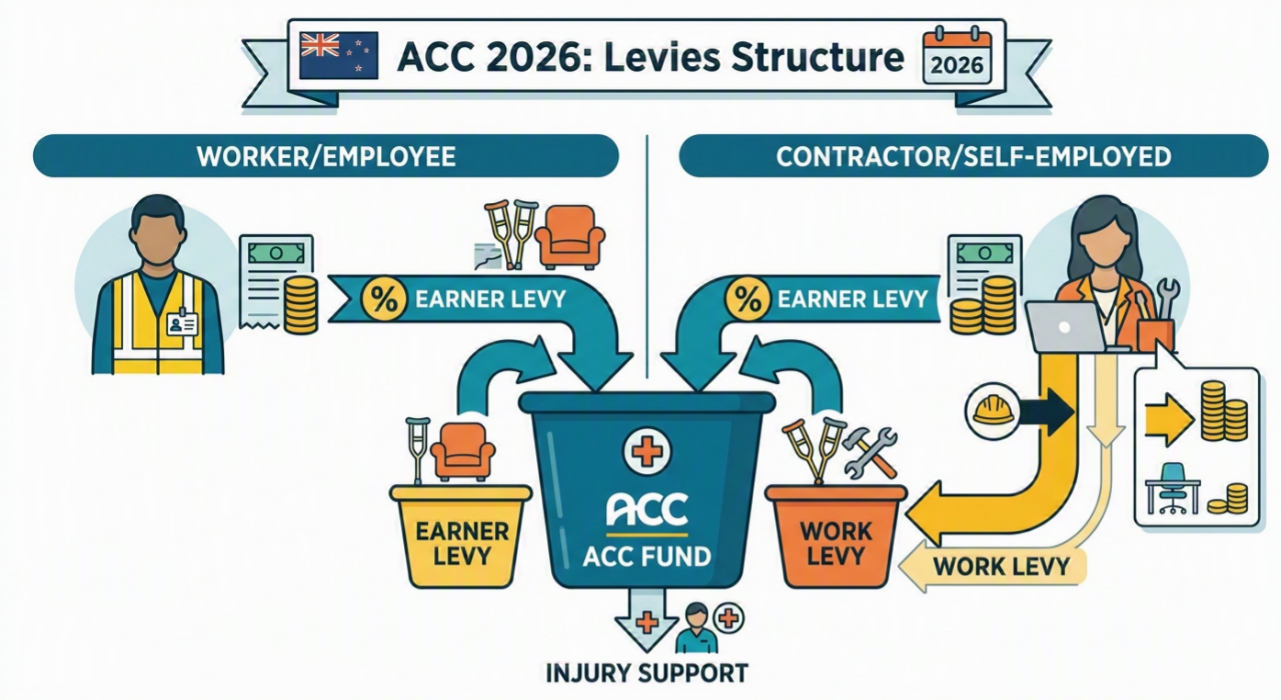
The Two Main Types of ACC Levy: Earner Levy vs Work Levy
If you are trying to figure out how much is ACC levy NZ going to cost you, you first need to understand that the scheme is split into different “accounts.” The two that affect your income are the Earner Levy and the Work Levy.
The Earner Levy
This is paid by absolutely everyone who earns a wage or salary. It covers you for non-work-related injuries (like coming off your mountain bike on a Saturday or burning yourself while cooking). If you are a standard employee, this is the only ACC levy you pay, and your employer deducts it automatically via the PAYE system.
The Work Levy
This is paid by employers and self-employed people. It funds recovery for injuries that happen specifically on the job. The amount paid is heavily dependent on the risk of your industry. A scaffolding company pays a much higher Work Levy than an accounting firm because the statistical risk of a workplace accident is far greater.
If you are an employee, you only pay the Earner Levy. If you are a self-employed sole trader or contractor, you wear both hats—meaning you pay both the Earner Levy and the Work Levy out of your own pocket.
If you want to see how this impacts your bottom line, use our Hourly-to-Take-Home-Pay-NZ to estimate your annual costs.
The 2026 ACC Earner Levy Rate & Annual Cap
Let’s look at the hard numbers for the 2026/2027 tax year. ACC periodically reviews its rates to ensure the scheme remains sustainable, and a scheduled increase took effect recently.
Effective from 1 April 2026, the ACC Earner Levy rate is 1.75% (or $1.75 for every $100 you earn). This is a vital update to keep on your radar, especially if you are budgeting for the year ahead.
However, there is a limit to how much ACC can take from high-income earners. For the 2026 tax year, the maximum liable earnings cap is set at $156,641.
If your salary is $200,000, you only pay the 1.75% levy on the first $156,641. Anything you earn above that cap is completely exempt from the ACC Earner Levy. This means the absolute maximum Earner Levy any individual will pay in 2026 is $2,741.22 per year.
2026 ACC Earner Levy by Income (Weekly Deduction)
To make it easy to see how this impacts your budget or your flatmates’ shared finances, here is a breakdown of the standard weekly ACC deduction based on various annual salaries:
| Annual Salary | Annual ACC Levy (1.75%) | Weekly ACC Deduction |
| $40,000 | $700.00 | $13.46 |
| $60,000 | $1,050.00 | $20.19 |
| $80,000 | $1,400.00 | $26.92 |
| $100,000 | $1,750.00 | $33.65 |
| $130,000 | $2,275.00 | $43.75 |
| $156,641 (Cap) | $2,741.22 | $52.72 |
| $180,000+ | $2,741.22 (Capped) | $52.72 |
How ACC Is Deducted From Your Payslip
If you are a standard PAYE employee, you never actually have to write a check to ACC. Your payroll software calculates it automatically. You might see it listed as “ACC,” “ACC Earner Levy,” or an internal code your payroll provider uses.
Note on “ACCEAR”: You may have seen this code in older threads or specific legacy payroll software. It is not an official IRD or ACC term. If you don’t see it on your payslip, don’t panic—check for “ACC” or “Levy” instead.
Let’s look at a realistic example for a mid-level professional earning $75,000 a year in 2026.
- Gross Annual Salary: $75,000
- Income Tax (2026 IRD Brackets): -$14,720.50
- ACC Earner Levy (1.75%): -$1,312.50
- Net Take-Home Pay: Roughly $58,967 (before other deductions like KiwiSaver).
In this scenario, our worker is paying about $25 a week toward ACC. It’s a noticeable chunk of change, but it ensures that if they are injured and off work for more than a week, ACC will step in to cover up to 80% of their pre-injury income.
Self-Employed & Contractors: How to Calculate and Pay the Work Levy
Things get vastly more complicated when you leave the comfort of standard employment and become a sole trader or contractor. Because you are essentially your own employer, you are responsible for paying ACC directly.
When you file your IR3 tax return at the end of the financial year, the IRD shares your income data with ACC. A few months later, you will receive an invoice directly from ACC. This invoice will include:
- The Earner Levy: 1.75% of your declared profit (up to the $156,641 cap).
- The Work Levy: A percentage based entirely on the risk profile of your job.
- The Working Safer Levy: A tiny flat rate that goes toward WorkSafe NZ.
The Minimum Liable Earnings Trap
Here is a massive trap for new contractors in 2026: If you work full-time (more than 30 hours a week), ACC applies a “minimum liable earnings” threshold. For the 2026/2027 tax year, this minimum is $50,501.
If your new business struggles in its first year and you only make $30,000 in profit, ACC will still calculate your levies as if you earned $50,501. They do this because if you get injured, they have to pay you a minimum liveable wage. If you work less than 30 hours a week, you must declare yourself as part-time to ACC to avoid being hit with this minimum threshold charge.
The BIC Code
Your Work Levy rate is dictated by your Business Industry Classification (BIC) code. A freelance graphic designer sitting at a desk might pay a Work Levy of just $0.15 per $100 of income. A forestry worker operating chainsaw might pay $3.50 per $100. Ensuring your accountant or bookkeeper uses the exact right BIC code is crucial, or you will overpay.
ACC CoverPlus vs CoverPlus Extra: What’s the Difference for Sole Traders?
By default, every self-employed person is placed on a policy called CoverPlus.
Under CoverPlus, if you are injured and can’t work, ACC will pay you up to 80% of the taxable profit you declared in your most recent financial year.
The problem? Business income fluctuates. If you had a terrible year, took time off, or bought a massive piece of machinery (like a new digger) that artificially drove down your taxable profit, your ACC cover will be dangerously low.
The alternative is CoverPlus Extra (CPX).
CPX is an agreed-value policy. You sit down with ACC and mutually agree on a set level of income cover—regardless of what your actual financials show. If you agree on $80,000 of cover, you will pay levies based on $80,000. If you break your leg the following week, ACC pays out based on that $80,000 figure.
How to Dispute an ACC Levy Invoice
If you open the mail and are shocked by a massive ACC bill, don’t panic. Errors are incredibly common, particularly for sole traders. The most frequent culprit is the wrong BIC code being assigned to your profile.
To dispute or fix an invoice:
- Do not ignore it; late penalties apply.
- Log into your MyACC for Business portal online.
- Check the BIC code listed under your profile.
- If it doesn’t reflect your daily activities, search for a more accurate, lower-risk code and request a change directly through the portal.
- ACC will typically recalculate the invoice and issue a credit note for the difference.
Frequently Asked Questions
Is ACC deducted on investment income?
No. The ACC Earner Levy strictly applies to “personal exertion” income. This means wages, salary, and business contracting profits. Passive investment income—such as interest from term deposits, dividends from shares, or returns from a PIE fund—is entirely exempt from ACC levies.
Do I pay ACC on rental property income?
Generally, no. Standard residential rental income (like having tenants in an investment property) is considered passive income and is not liable for ACC. The only exception is if you are running a registered commercial accommodation business, like a multi-unit motel or a highly commercialized short-term rental operation, which requires significant personal exertion.
Can I opt out of ACC and just use private insurance?
No. ACC is a compulsory, universal social insurance scheme. You cannot opt out of paying the Earner Levy, even if you hold comprehensive private income protection or health insurance. Private insurance is designed to work alongside ACC (for example, by covering illnesses, which ACC does not cover, or topping up the remaining 20% of your lost income).
What happens if I have multiple jobs? Do I overpay?
If you have a primary job and a side hustle, both employers will deduct the ACC levy from your paychecks. If your combined income from all sources exceeds the 2026 cap of $156,641, you will inevitably overpay your Earner Levy during the year. Fortunately, the IRD reconciles your taxes at the end of the financial year, and they will automatically calculate the overpayment and refund the excess ACC directly to your nominated bank account.
Conclusion
While nobody loves seeing deductions on their payslip, the ACC scheme provides a world-class safety net that ensures Kiwis aren’t left financially destitute after an accident. For standard employees, the 2026 rate of 1.75% is fixed and handled for you. But if you are stepping into the world of contracting, treating your ACC levies with the same respect as your income tax will save you from nasty cash-flow surprises at the end of the year.
Disclaimer: This is general information, not personalized financial advice. ACC rates, tax brackets, and rules are subject to legislative changes. For customized tax or levy advice, please speak to a registered accountant or financial adviser.
Date: 28/06/2026
Author: Luca Tariciotti
Leave a Reply